TAFE SA invites sector expertise to help shape the future of early childhood training

 Marketplace
Educators, service leaders and training professionals across Australia are invited to contribute their experience to the TAFE SA Centre of Excellence in Early Childhood Education and Care, with expressions of interest open until January 2027.
The people working in early childhood education and care (ECEC) bring knowledge that is essential to developing relevant training: how services operate, what learners need to understand and where workforce pressures affect opportunities to enter and build a career.
The TAFE SA Centre of Excellence in Early Childhood Education and Care is inviting professionals across Australia to register their interest in contributing that expertise to its research, evaluation and development work.
The expression of interest (EOI) will help the Centre identify potential contributors for future consultation and collaboration as it refines projects and pilots new initiatives.
At the heart of the invitation is a commitment to listening to the people who lead, deliver and support early childhood education and care.
Building on an established foundation of sector engagement
Since its establishment, the Centre has built relationships and networks that have helped identify emerging issues and opportunities across ECEC and inform its work.
This engagement has included meetings, conferences, forums, advisory groups and working groups, drawing on connections with educators, employers, peak bodies, government representatives and specialists. Existing relationships across TAFE SA, its staff and the Centre, together with referrals and introductions from trusted sector contacts, have helped extend that reach.
Practitioners and leaders within and beyond TAFE SA have reviewed concepts, tested ideas and provided practical advice on workforce challenges. Stakeholders with relevant expertise or direct experience have contributed at different stages of project design and development, including work on Introduction to Autism for Early Childhood Educators, Effective Mentoring for Early Childhood Education and Care, the Vocational Degree in Early Childhood Education (Birth to 5 years) and the Diploma Traineeship.
These contributions help the Centre assess whether proposed approaches reflect workplace realities, respond to learner needs and address the challenges services face.
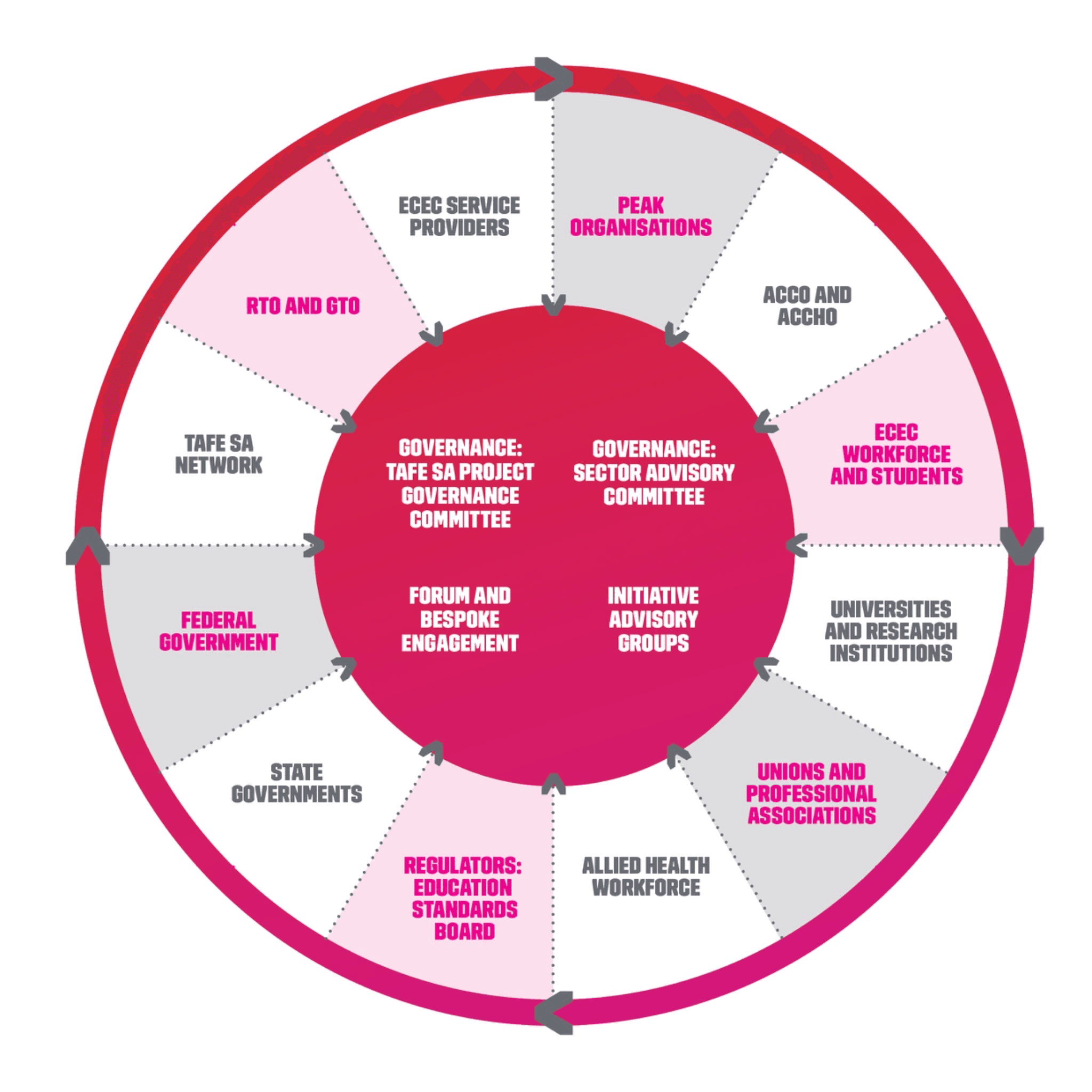
“The Centre’s Wheel of Engagement illustrates its approach to involving sector contributors in its work.”
Opening the door to a broader range of voices
The EOI builds on this foundation by creating an open and transparent pathway for people with relevant expertise, lived experience or an interest in the Centre’s work to contribute. It expands existing relationships and invites participation from people who may not previously have had an opportunity to be involved.
The Centre is seeking a broad range of perspectives, including those of educators, service leaders, employers and registered training organisations (RTOs). Trainers, peak bodies, regulators, researchers and government representatives are also invited to contribute, bringing both strategic perspectives and frontline workplace experience.
Regional, rural and remote voices are particularly welcome. Their experience can help identify training and workforce needs that differ from those encountered in metropolitan settings, including barriers to participation and access to professional learning. Contributions from people living and working in very remote communities may also bring attention to challenges and opportunities the Centre has not yet considered.

The invitation recognises that expertise comes from different roles, career stages and settings. Experience supporting students on placement, developing learning resources, delivering vocational education or leading a service can all inform the Centre’s work.
Sharing the invitation through sector networks, newsletters and publications such as The Sector will help the Centre reach a wider audience and develop a larger, more diverse pool of contributors across Australia.
The online form allows respondents to select areas of interest and suggest additional topics. It also captures their role, organisation, location and ECEC experience to help inform future engagement. This allows people to identify their particular knowledge, experience and interests, helping the Centre involve the right contributors at the right stage of a project.
Connecting training with the realities of practice
The Centre’s invitation focuses on four themes: simulations in education, training packages, learning materials, and workforce trends and their impact on vocational education.
The EOI form translates these themes into opportunities to contribute to learning resource development, simulation curriculum design, training and assessment delivery, and workforce discussions.
Potential contributions include reviewing resources for accuracy and relevance, validating workplace examples and assessment tools, advising on realistic simulation scenarios, and sharing insights about learner engagement and workplace-based learning.
Respondents can also indicate an interest in discussing workforce challenges and expectations for student placement activities.
These conversations offer opportunities to connect training with the realities of practice. Issues that sector contributors could help explore include student preparedness, child safety and inclusive approaches to learning and work.
As the Centre progresses priorities such as the Vocational Degree in Early Childhood Education (Birth to 5 years) innovative approaches to placements and access to high-quality simulated learning environments, collaboration will help ensure proposed solutions are practical, evidence-informed and responsive to workforce needs.
Through advisory groups, consultations, surveys and project activities, contributors can play a direct role in shaping vocational education and training for Early Childhood Education (Birth to 5 years). Their collective knowledge can inform workforce pathways, strengthen qualifications and support the development of the next generation of educators and early childhood teachers.
Supporting pathways into and through ECEC
Based at TAFE SA’s Adelaide Campus on Wauwi (Light Square), the Centre brings together educators, researchers, sector leaders and communities to develop accessible, evidence-informed training and resources.
Jointly funded by the Australian and South Australian governments, it forms part of the national network of TAFE Centres of Excellence established under the National Skills Agreement.
Its work spans three priority areas: entry pathways, career development, and retention and recognition. Together, these priorities support people to begin, build and sustain careers in ECEC.
The EOI will create an ongoing register of sector expertise to inform initiatives, pilots, reviews, consultations and advisory activities. Drawing on a wider range of contributors will support more representative consultation and strengthen evidence-informed decision making.
That input is intended to strengthen workforce capability, support pathways into the sector, respond to emerging workforce demand and address the needs of First Nations learners and communities.

Purposeful participation that values contributors’ time
The EOI is an initial registration of interest. It does not create an obligation to participate in future activities.
As projects develop, the Centre will use an engagement matrix to assess responses and inform the structure and composition of consultation and collaboration opportunities.
People who have expressed interest will be invited to relevant activities, with information about the purpose, format and timing provided so they can consider whether participation suits their interests and availability.
As the Centre’s work develops, it is refining how and why it seeks sector input. Clearly explaining the expertise or experience needed for each activity will help contributors understand how their involvement can influence the work and why their contribution is valued.
The Centre recognises the workload and time pressures experienced across ECEC and intends to make engagement purposeful, flexible and respectful of participants’ capacity.
It will also provide regular updates to the EOI group. These may relate to respondents’ topics of interest, vocational education or developments within the Centre itself.
ECEC professionals and RTO representatives interested in contributing their knowledge and experience can complete the TAFE SA Centre of Excellence expression of interest form.
Expressions of interest will remain open until January 2027.
More information about the Centre’s priorities and approach is available on the TAFE SA website and in its overview brochure.


Don’t miss a thing




Related Articles