Does rest need permission? Rethinking participation in OSHC
This is the third article in Participation in the Shared Life of OSHC. Part 2 looked at how age shapes what happens between children. Here, I turn to what participation can look like when a child becomes quieter or chooses to do less.
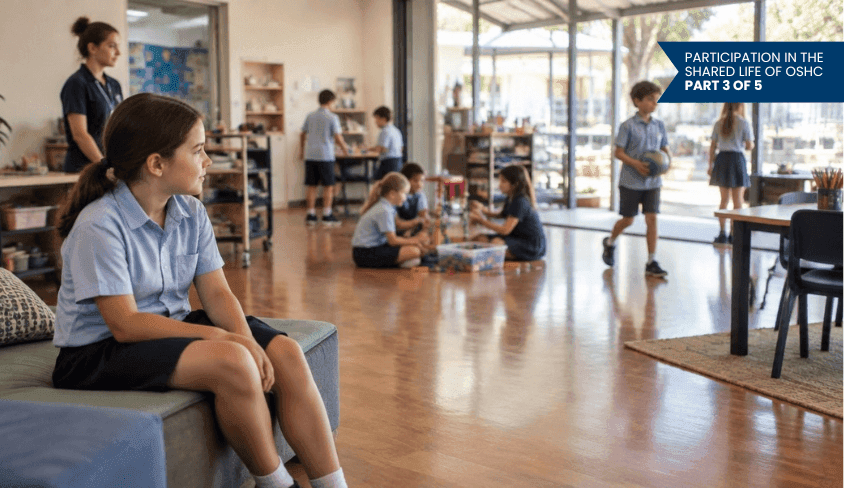
An ordinary OSHC moment might begin with a child sitting near the edge of the room, watching what is happening around them. One educator offers drawing. Another suggests the game outside. A few minutes later, someone asks whether they are bored.
The intent is generous. The educators have noticed the child and want to make sure the program feels open to them. Several invitations in quick succession, though, can carry another message: sitting and watching are not enough.
Passive leisure now appears explicitly in My Time, Our Place V2.0 and ACECQA’s guidance on play and leisure in OSHC. The National Quality Standard separately names children’s needs for sleep, rest and relaxation. That recognition matters, but it does not make rest easy to choose.
I keep returning to what makes rest available in practice. A quiet space may be there while everyday expectations still favour visible activity. If slowing down brings repeated redirection or requires the child to explain the pause, rest remains conditional. The child may be doing less and still be part of the shared life of the service.
Recognition is not the same as permission
A philosophy may recognise rest and the program may include quiet experiences. What matters is what happens after a child sits down.
Some children watch before deciding whether to enter. Others may be content simply to remain alongside. When either position prompts one invitation after another, rest is present in the program but difficult to choose.
I use practical permission to describe these everyday interactions. It is there when an educator accepts a decline and lets a pause remain a pause. When the child returns, the quiet time does not have to be explained or treated as a problem. No one needs to announce, “You may rest.” The permission sits in the response.
When an invitation becomes an expectation
Invitations matter in OSHC. An educator’s suggestion can make entry easier and let a child know they are welcome. One thoughtful invitation may be exactly what is needed.
The fourth invitation can feel different. After declining drawing, outdoor play and a board game, “What would you like to do?” may no longer feel like an open question. By then, the child may hear that they must eventually choose something.
There are good reasons to check in. An educator may be wondering whether the child is excluded, distressed or unsure how to enter. There may also be pressure to show that every child is engaged.
Quiet participation leaves more uncertainty. It asks educators to stay attentive without immediately moving the child into an activity. Visible activity is easier to read and record than a child simply being there.
The test is whether the child can decline. If the invitation keeps returning in another form, “no” has become the beginning of a negotiation, not an answer that can stand for a while.
What a pause may mean
Stillness does not tell us, by itself, whether a child is resting. A child sitting apart may be enjoying solitude or listening nearby. They may also be excluded or unsure how to join.
Neither “rest” nor “disengagement” can be read straight from the child’s posture. Educators still need to work out what is happening for this child, at this point in the afternoon.
Relationships provide context. Educators draw on what they know about the child and notice whether the pattern is familiar or has changed. “Would you like some company, or are you happy sitting here?” carries a different assumption from “What are you going to do?”
Even then, the answer may be partial. A child may want privacy, lack the words for what is happening or genuinely be fine.
Quietness can conceal a need for support. Yet if every pause is treated as a problem, rest depends on adult approval. Letting the child’s first answer stand still leaves room for attention. An educator can remain nearby and notice what happens next.
Rest cannot be standardised. What feels restorative to one child may feel restrictive to another, and the same child may choose differently tomorrow. A compulsory quiet period only replaces one expected form of participation with another.
Participation without performance
A study of passive leisure in one Australian MTOP V2.0 pilot service offers a useful example. Jennifer Cartmel, Bruce Hurst and colleagues report educators’ and children’s descriptions of the space as restful and as a place to talk and observe others. I do not take one service as a model for OSHC as a whole. I draw on the study because it helps us see how lower visible activity can remain part of the social life of OSHC.
I think of this as a change in the intensity of participation. I use the phrase to name a familiar movement across an OSHC afternoon, not a formal developmental category. Participation may continue even when it becomes less visible to adults.
For me, practical permission includes room to move into that lower-intensity position without having the child’s place in the group called into question.
Element 2.1.1 of the National Quality Standard gives rest a clear place in OSHC. It requires services to provide for each child’s wellbeing and comfort, including appropriate opportunities for sleep, rest and relaxation.
Article 31 of the Convention on the Rights of the Child recognises children’s right to rest and leisure, age-appropriate play and recreation, and free participation in cultural life and the arts. General Comment No. 17 describes leisure as largely discretionary time that children may use actively or inactively, and identifies time free from other demands as one condition for realising these rights.
These sources establish that rest belongs in children’s lives. They cannot tell us whether this child needs quiet at 3.30 pm or when an educator should check in. For educators, that judgement is made with the child and in the context of the afternoon.
What happens when a child does less
Back at the edge of the room, the child still needs to be noticed. What changes is the educator’s next move. The educator begins with curiosity about what the child is already doing with that time, without assuming visible occupation is needed.
On one afternoon, the child may want help to enter the group and welcome an invitation. On another, staying nearby without asking them to perform engagement for us may be the more responsive choice.
Does rest need permission? In OSHC, adult responses, routines and expectations shape what children can do with their time, so I think it often does. We see that permission when a child can do less without losing their place in the shared life of OSHC.
In the next article, What Can Children Actually Use?, I turn to the practical availability of spaces and resources. What can children count on using once the afternoon is underway?
Author
Belinda Wright is an Australian OSHC practitioner-researcher, instructional designer and sector leader with extensive experience across Outside School Hours Care, educator capability development and professional learning. She is the Founder and Director of Learning at Learn OSHC and a PhD Candidate, with doctoral research focused on Outside School Hours Care and educational leadership in Australian school-age care contexts.

Don’t miss a thing



Related Articles