There’s a Bear in There: What future teachers can learn from Play School
 Article
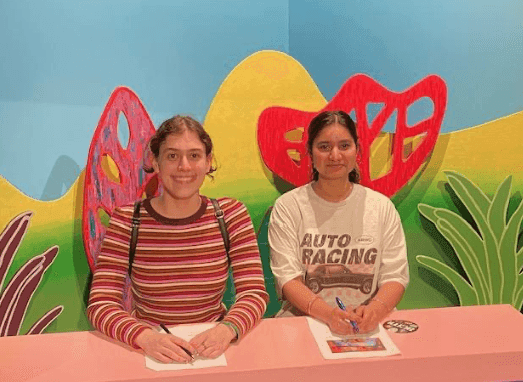
Recently, a group of first and second-year pre-service early childhood teachers from Australian Catholic University visited the Play School: Come and Play! exhibition at the Australian Centre for the Moving Image (ACMI) as part of their studies exploring environments for learning in the early years.
The visit offered far more than nostalgia. It created an opportunity for students to experience firsthand how environments can shape curiosity, participation, creativity, and learning.
For many students, Play School is deeply familiar. It is tied to childhood memories of routine, comfort, storytelling, and play. Although many students entered the exhibition with strong memories of Play School, this was not the case for everyone. For some, the exhibition represented an entirely new cultural experience. This became an important reminder that childhood texts and experiences are shaped by culture, migration, family context, and access. Interestingly, students unfamiliar with Play School often noticed different aspects of the exhibition, particularly the intentionality of the design, storytelling, and interactive environments, rather than the nostalgia attached to them.
Stepping into the exhibition reveals something many students had never previously considered: the immense complexity behind what appears on screen. What once felt simple and effortless suddenly becomes visible as highly intentional pedagogical work.
As one student reflected:
“It’s amazing how long it takes to make one episode.”
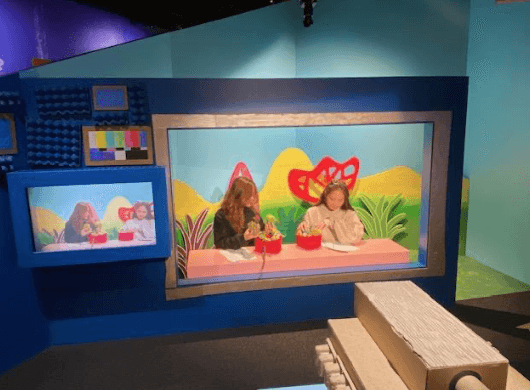
This observation became an important point of discussion throughout the visit. Students began to recognise that every aspect of the program—from storytelling and music to set design, props, lighting, and pacing, is thoughtfully curated to engage young children.
Within a unit focused on environments for learning in the early years, this experience offers an important provocation. Learning environments are often discussed in terms of furniture, resources, or room arrangement, yet the exhibition demonstrates that environments are also sensory, emotional, imaginative, and relational. They are carefully designed experiences that invite participation.
Students moved through the exhibition not simply as observers, but as participants. They crawled into spaces, interacted with materials, revisited familiar characters, and engaged with one another in playful and unexpected ways. Familiar figures such as Big Ted and Jemima became powerful relational anchors within the space. Their presence reminded students that materials and objects are never neutral; they carry memory, familiarity, and emotional significance.
Within the exhibition, these characters quietly invite interaction. They sit, wait, and offer themselves as companions in play, storytelling, and imagination. In doing so, they highlight how environments can hold relational possibilities, not only through educator presence, but through the materials and figures that inhabit the space.
For many students, the exhibition also expanded their understanding of storytelling and media within early childhood contexts. A student observed:
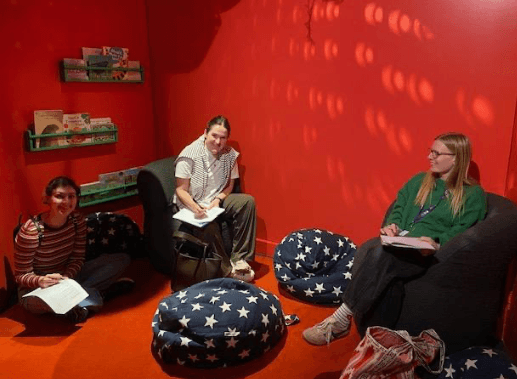
“I learned that storytelling and digital media can encourage creativity.”
This reflection speaks to the increasingly important role digital and multimodal experiences play in the lives of young children. Rather than positioning media as passive entertainment, the exhibition demonstrates how storytelling, production design, sound, movement, and interaction can work together to foster imagination and engagement.
Off-site learning experiences expose pre-service teachers to environments intentionally designed at a scale and level of immersion rarely possible within university settings. The exhibition offers a reminder that learning can occur across museums, galleries, public institutions, media spaces, and community settings, not solely within early childhood settings. Experiences such as this remind pre-service teachers that some forms of learning can only be understood through participation, immersion, and encounter.
Importantly, the visit encouraged students to think differently about the role of play. What may initially appear to be simple entertainment quickly revealed itself as layered, purposeful, and deeply pedagogical. For some students, the behind-the-scenes process was surprising:
“There’s so much beyond just an episode of Play School, so much to learn.”
Perhaps this captures the value of the experience most clearly. The exhibition invites pre-service teachers to look beyond the surface of environments and ask deeper questions about how spaces shape learning, belonging, participation, and imagination. It encourages them to think critically about the environments they themselves may one day design for young children.
Experiences such as this matter because they move learning beyond discussion and into encounter. They allow students to feel the impact of thoughtfully designed environments, to notice the emotional and relational dimensions of space, and to understand that play is never “just play.” It is communication, creativity, storytelling, connection, and learning woven together.
For pre-service teachers preparing to enter the early childhood profession, these are powerful lessons to carry forward.
As part of the visit, students were also encouraged to pitch their own idea for a Play School episode. From imaginative adventures to sustainability themes, sensory storytelling, and community-focused narratives, the ideas reflected both creativity and an emerging understanding of how thoughtfully designed experiences can engage young children.
Perhaps somewhere amongst this group of students is a future Play School writer, designer, or presenter, already beginning to imagine new possibilities for young children’s learning.


Don’t miss a thing




Related Articles