Moving beyond symbols to embodied understanding: reimagining reconciliation in the outside school hours care space
 Article
Across Australia, early childhood and outside school hours care services are being challenged to move beyond symbolic acknowledgements of First Nations cultures and towards genuine reconciliation. While flags, artwork, and cultural celebrations remain important, many educators are asking how we can support children to develop a deeper understanding of reconciliation as a lived practice rather than a symbolic concept.
As educators, we are often challenged to look beyond what children can repeat and consider what they truly understand. This challenge became particularly evident during our recent exploration of Reconciliation. While the children eagerly engaged in discussions and creative experiences, their responses initially revealed a pattern common in educational settings: an understanding grounded in symbols rather than meaning.
Many children spoke about Reconciliation through familiar phrases such as "being kind to the Butchulla people" or by repeatedly drawing Aboriginal and Torres Strait Islander flags. While these responses reflected positive intentions and growing awareness, they also highlighted a pedagogical dilemma. The children were demonstrating familiarity with the language and symbols of Reconciliation, but the deeper relational and structural concepts remained largely unexplored.
This prompted an important question: How do we move beyond symbolic representation and support children to develop a genuine understanding of what reconciliation means?
The answer emerged through embodied learning.
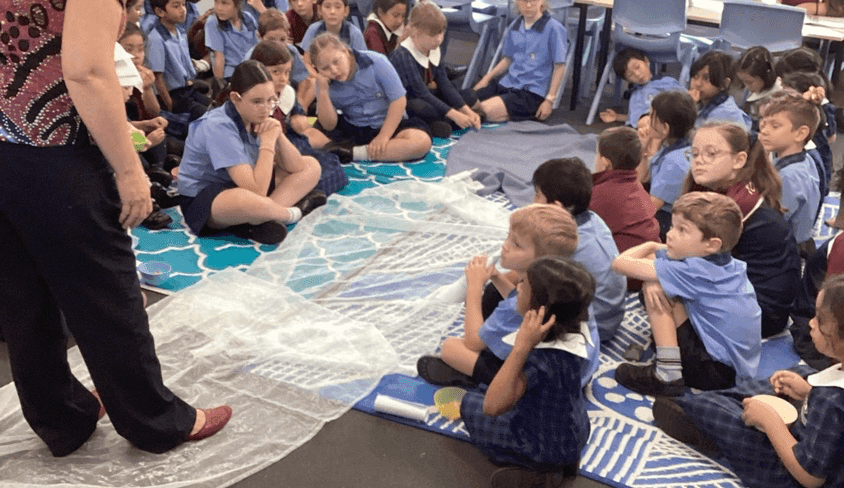
To shift the conversation from abstract concepts to lived experience, a simple provocation was introduced. A length of blue fabric was placed across the learning space, creating a "river" that physically divided the multi-age group. The children were told that the people on either side of the river had experienced a disagreement and that their challenge was to work out how to cross the river and repair the relationship.
Almost immediately, the children's thinking transformed.
Rather than focusing on what reconciliation looks like, they began exploring what reconciliation requires.
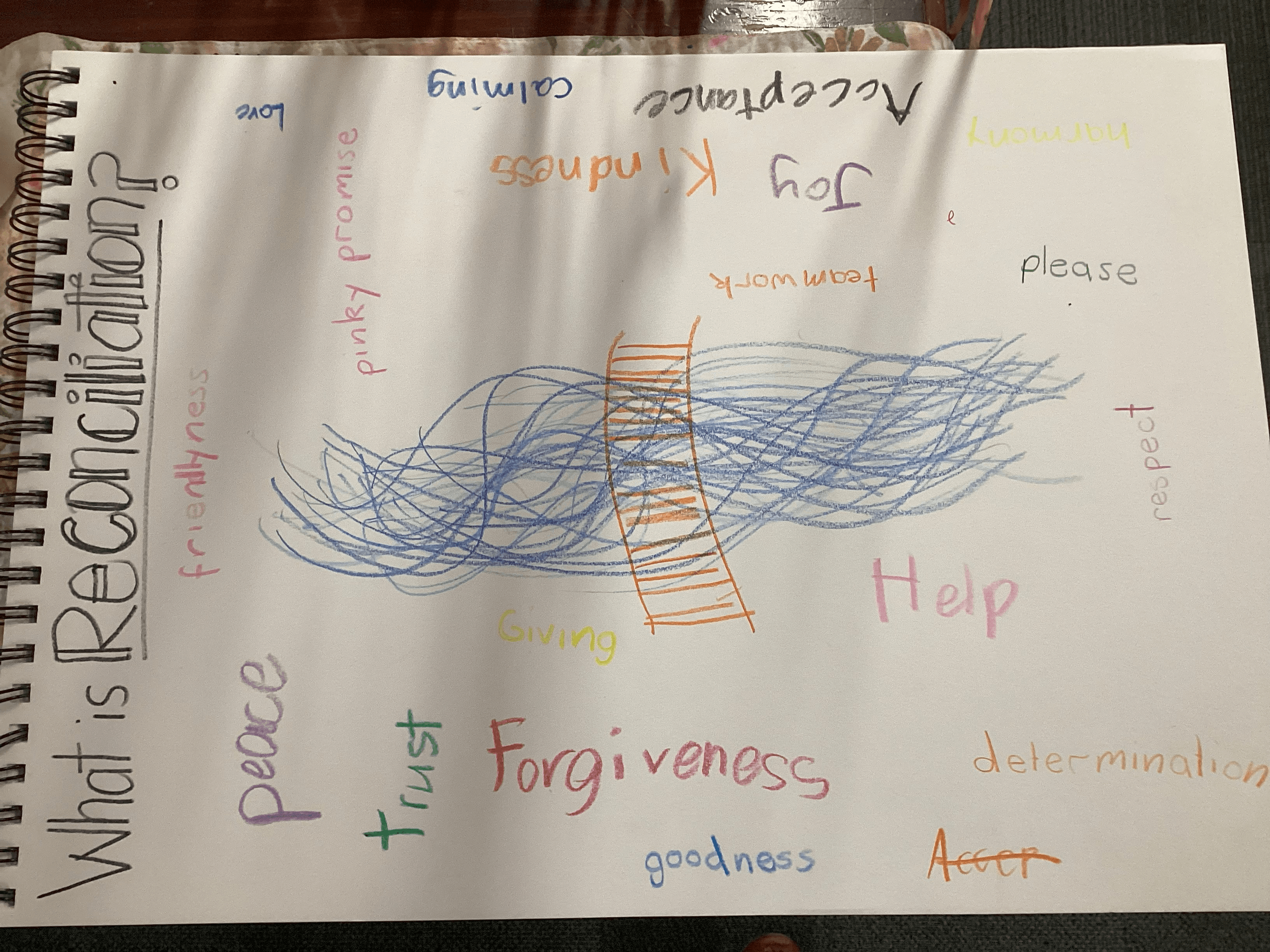
When Hudson (5) suggested, "We need to build a bridge," the metaphor resonated instantly.
The bridge became both a practical solution and a powerful symbol for repairing relationships. As the discussion unfolded, children began identifying the emotional and social foundations needed to construct that bridge.
Charlotte (7) and Arthur (6) spoke about the importance of teamwork. Ciara (8) suggested that people needed to put aside their differences. Mia (6) and Hudson (5) discussed making promises and "pinky promises," recognising that reconciliation involves commitment and accountability. Senaya (8) and Ethan (7) identified forgiveness as an essential part of healing. Perhaps most powerfully, Nyasha (11) explained that reconciliation required people to "trust together to create a bond to be friends forever and celebrate our differences."
In that moment, the conversation moved far beyond tokenistic understandings. Rather than focusing on sameness, the children recognised that strong relationships are built through respect, trust, forgiveness, and the celebration of difference.
The physical river provided a visible representation of an invisible concept. Through collective dialogue, the children transformed an abstract social and historical idea into a shared human experience.
The significance of this learning can be understood through established educational theories. Jean Piaget proposed that children construct understanding through active engagement with their environment. By physically experiencing separation and collaboratively solving the problem of connection, the children were able to develop new understandings of reconciliation through firsthand experience rather than memorisation.
Lev Vygotsky's theory of social constructivism was equally evident. The multi-age nature of the group created rich opportunities for the co-construction of knowledge. Younger children contributed ideas such as "show kindness" and "say please," while older children introduced more complex concepts including trust, compromise, and relationship-building. Through shared dialogue, children extended one another's thinking and developed increasingly sophisticated understandings together.
The experience also reflects Maurice Merleau-Ponty's concept of embodied cognition, which suggests that learning occurs through the body as well as the mind. By standing on opposite sides of the river, experiencing separation, and imagining the process of reconnecting, children engaged with reconciliation in a tangible way. Concepts such as listening, vulnerability, forgiveness, and connection became experiences they could feel rather than ideas they could simply describe.
Importantly, this experience aligned strongly with the Early Years Learning Framework. Children demonstrated Outcome 1 as they developed empathy, respect, and an appreciation of diversity. Outcome 2 was evident as they explored fairness, relationships, and their responsibilities to others within a broader social context. Outcome 4 emerged through problem-solving, inquiry, and the transfer of personal experiences of friendship and conflict into a larger conversation about reconciliation.
For educators and leaders, this experience highlights the importance of critically reflecting on the difference between participation and understanding. It challenges us to consider whether our reconciliation initiatives create opportunities for children to engage deeply with complex ideas, or whether they remain focused primarily on symbolic representations. Meaningful reconciliation education requires intentional pedagogy that invites children to explore, question, and construct understanding through authentic experiences.
This reflection serves as a reminder that meaningful learning often occurs when educators are willing to rethink familiar approaches. While symbols, artwork, and cultural representations have an important place within Reconciliation education, they are most powerful when accompanied by experiences that allow children to engage with the deeper ideas they represent.
The Friendship Bridge was not simply an activity about crossing a river. It was an invitation for children to understand that reconciliation is not something we draw, colour, or talk about in isolation. It is something we actively build through trust, listening, forgiveness, and respect.
Perhaps the most significant learning of all was that children are far more capable of engaging with complex social concepts than we sometimes assume. When provided with meaningful experiences and opportunities for dialogue, they move beyond repeating messages and begin constructing genuine understanding.
In doing so, they remind us that reconciliation is, at its heart, about relationships, and that children can offer profound insights into how those relationships are formed, repaired, and sustained.


Don’t miss a thing




Related Articles