



Mount Druitt childcare quality lifts sharply as network-backed model shows results, independent evaluation finds
 Article
Western Sydney University evaluation credits The Hive's Early Childhood Educators’ Network with lifting quality across roughly 40 services in one of NSW’s most disadvantaged postcodes.
An independent evaluation by the TeEACH Research Centre at Western Sydney University has found that a six-year program backing early childhood educators across Mount Druitt has lifted early childhood education and care quality across the 2770 postcode, one of the most disadvantaged in New South Wales.
Since The Hive, a place-based initiative of United Way Australia, began working with early childhood services in Mount Druitt in 2017, the share rated ‘meeting’ or ‘exceeding’ the National Quality Standard has risen from 43 to 90 per cent. Over the six years its Early Childhood Educators’ Network (ECEN) has been running, that figure rose from 77 to 90 per cent, with the largest gains in ‘educational program and practice’.
These results are largely attributed to The Hive's 2770 Early Childhood Educators' Network (ECEN), one of several initiatives through which The Hive supports early childhood education and care services in Mount Druitt.
Rather than funding individual centres, The Hive equips, connects and mentors educators across 40 early childhood education and care centres. Educators take stronger practice into their work with children and then return to the network to share strategies with one another about what was effective.
A social network analysis within the evaluation shows a strengthened early years ecosystem across Mt Druitt, with 68 percent of services now connecting to each other outside of Network gatherings, sharing learnings and offering peer support. Preschool attendance in postcode 2770 rose to 80.2 per cent over the evaluation period, up from 76.4 per cent, growing faster than in Blacktown LGA or NSW as a whole. That increase reflects both the engagement of educators in the Network and other intentional enrolment work by The Hive.
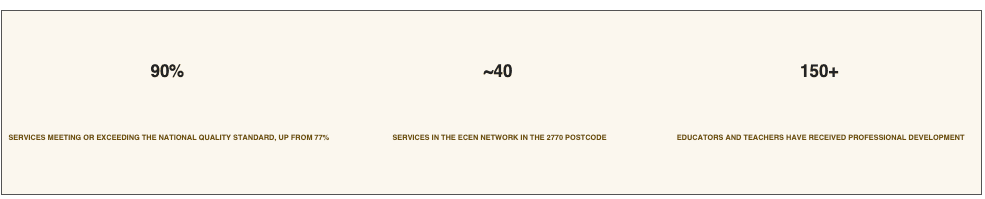
“This evaluation shows what’s possible when you invest in the people already doing the work. Over six years, our Early Childhood Educators’ Network has helped lift the share of services meeting or exceeding the National Quality Standard to 90 per cent, in one of the most disadvantaged postcodes in New South Wales”.
— Lyndsey McKee, CEO, United Way Australia
Of fifteen criteria Western Sydney University used to assess the network’s impact, twelve showed strong evidence of positive change and two showed good evidence; the sole area of mixed evidence was children’s school readiness, which the evaluators linked largely to the pandemic’s disruption to early development nationally.
Educators consistently reported stronger confidence and wellbeing as a result of the network, describing it in focus groups as a source of connection and support in a sector where burnout drives high staff turnover.
Children in Mount Druitt are more likely than the state average to start school with a developmental vulnerability, which makes consistent, well-supported educators especially important; the evaluation found the network helped services better identify and respond to individual children’s needs, from behaviour support to early referrals for extra help.
The evaluation captures what that support looks like in practice. In one case, an educator’s use of new strategies as collaboratively designed through the Network and connected allied health services, helped a non verbal child with autism begin to develop spoken language, easing the shame and fear his parents had been carrying. In another, an educator described how the network helped colleagues who had been dismissed as “just a nanny” build the confidence to be recognised as skilled professionals.
The evaluators concluded the ECEN is lifting the quality of early childhood education across one of the most disadvantaged postcodes in the state, and could be a model for the government to consider in similar communities.
“ We designed this Network so no educator has to solve problems on their own. We have connected educators together as we all have the goal to support the children in our community. Now they are picking up the phone to connect with each other even outside our gatherings.
— Jean Villacorta, Early Years Strategy Lead, The Hive


Don’t miss a thing




Related Articles