Educator wellbeing debate sparks calls for deeper workforce reform in ECEC

 Article
We need to talk about the collective delusion currently gripping the Early Childhood Education and Care (ECEC) sector. Every week, a new headline details the staffing crisis: centers closing rooms, exhausted educators walking out, and a sector on the brink of structural collapse.
In response, governments and corporate operators throw millions of dollars at the problem. But look closely at where that money goes, and you will find an industry-wide grift. We are spending fortunes on "educator well-being initiatives," mindfulness apps, mental health webinars, and resilience training.
It is the ultimate corporate distraction technique. By funding wellness bandages while ignoring systemic bleeding, the ECEC sector is engaged in a profound act of institutional gaslighting. The implied message to educators is as clear as it is toxic: “The environment isn't broken; your coping mechanisms are just weak.”
"A breathing exercise cannot fix a fractured ratio. A meditation app cannot pay the rent on a poverty-level wage. And a wellness webinar cannot create the paid administrative hours required to survive a crushing compliance workload."
It is time to peel back the PR veneer and expose the true cost of an industry that is quite literally breaking the bodies of its workforce.
The Biological Bill: It’s Toxic Stress, Not Tiredness
For years, the sector has treated educator burnout as an emotional luxury, a case of "feeling tired" or "getting overwhelmed." But biomedical research has caught up to the reality on the ground, and the data is horrifying.
A 2023 study published in Psychology in the Schools moved past self-reported stress and measured the biology of early childhood educators using hair cortisol biomarkers. The findings revealed that the daily reality of the ECEC environment triggers toxic stress, a prolonged, unbuffered physiological response that alters the human endocrine system.
When you trap an educator’s nervous system in a permanent fight-or-flight loop, the body pays the bill. In that same baseline study, 63% of early childhood educators met the clinical criteria for Major Depressive Disorder, and 41% met the criteria for Generalized Anxiety Disorder.
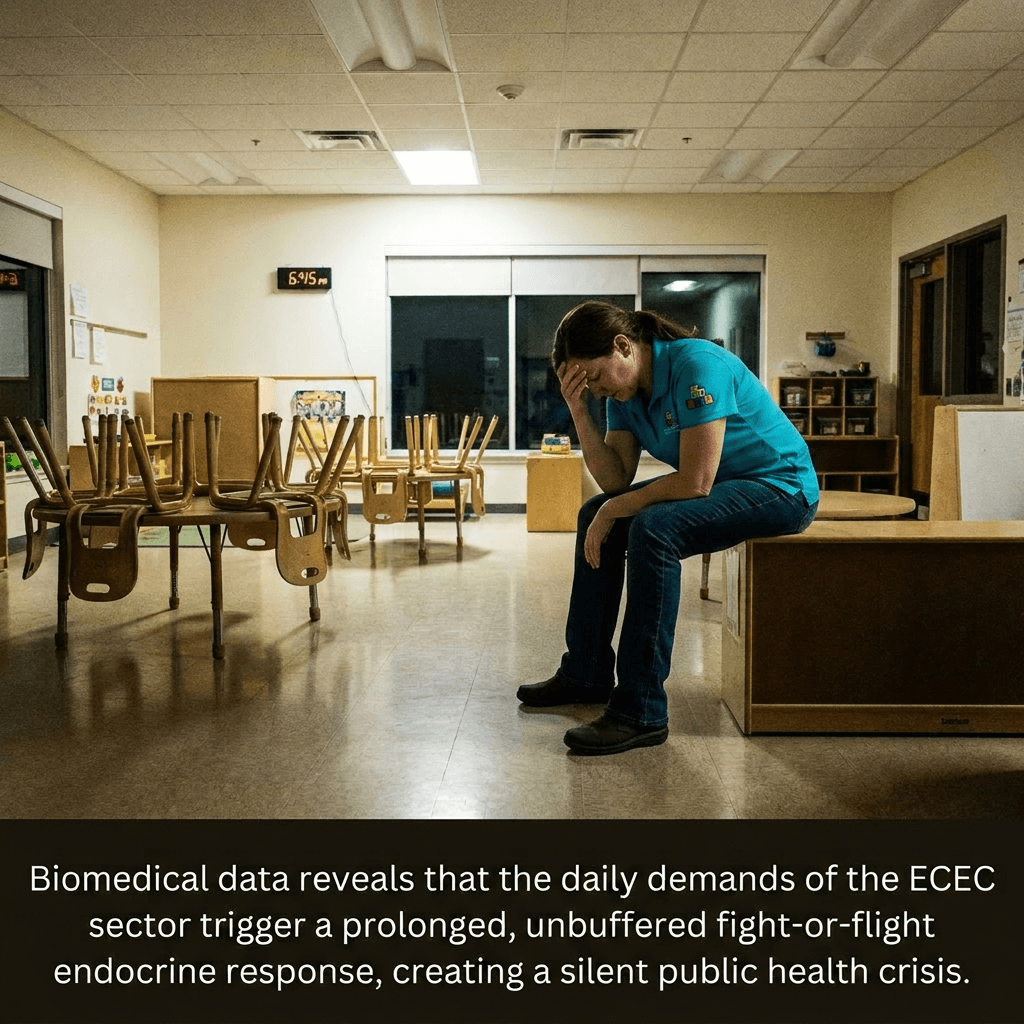
This isn't a lack of personal resilience. This is a public health crisis masquerading as a staffing shortage. Educators are experiencing executive function depletion, impaired decision-making, and chronic physical fatigue because their bodies are treating their workplaces as active threat zones.
The Scam of the Wellness Industry
Why, then, do we keep seeing investments in "mindfulness"? Because individualizing a systemic problem is highly cost-effective.
If an operator acknowledges that the crushing regulatory compliance burden, the lack of sick leave, and the abysmal pay scales are driving workers away, they have to change their operational model. They have to alter their profit margins.
But if they reframe burnout as an individual failure of self-care, the responsibility shifts entirely to the worker. It is a masterful shield. It allows institutions to claim they care about staff welfare, effectively buying compliance and ticking corporate social responsibility boxes, without ever fixing the root causes of the distress.
We have weaponized wellness to avoid doing the hard work of structural reform.
The Hypocrisy of "Partial Institutionalization"
At the heart of this crisis lies a foundational flaw: the partial institutionalization of the early childhood sector. The industry wants to have it both ways, creating a structural hypocrisy that is tearing the workforce apart.
The Dilemma of partial Institutionalization
High Institutionalation (the demands)
Extreme regulatory compliance & legal liabilities
Factory-like mechanical scheduling and strict pacing
Crushing documentation, diagnostic tracking, and audit loads
Low Institutionalation (the support)
Poverty-level market wages tracking near entry retail
Abysmally low professional status and social standing
Casualized environments missing basic professional provisions
On one hand, we demand high institutionalization when it comes to accountability. Educators must navigate intense regulatory frameworks, maintain hyper-vigilance for child safety, manage complex behavioral needs, and execute endless pedagogical documentation. They are treated like high-stakes clinical or corporate professionals when there is paperwork to be audited.
Yet, on the other hand, the industry operates with low institutionalization when it comes to supporting those same workers. They are paid wages that track closer to retail than education. They are denied the professional status, career progression, and structural support afforded to primary or secondary school teachers. They are expected to perform the duties of a highly regulated institution while being compensated as if they are doing informal domestic labor.
You cannot demand total institutional compliance from a workforce while offering precarious, undervalued labor conditions. That mismatch is precisely why a third of qualified educators plan to leave the field within the next four years.
Stop Mediating, Start Reforming
The ECEC sector does not need more yoga mats, and it certainly does not need more funding funneled into wellness consultants. Until government funding and sector operations are directly tied to binding, systemic changes, such as mandatory living wages, fully funded administrative hours outside of child ratios, and a radical reduction in redundant regulatory paperwork, any talk of "educator well-being" is a farce.
We need to stop telling educators to breathe through the trauma of a broken system. It is time to stop fixing the women and men in the rooms, and start fixing the infrastructure that is breaking them.
Author:
Lindsay Smith is an industry specialist and consultant developing national compliance, health, and safety management frameworks for the early childhood sector. Her work focuses on mapping regulatory requirements and establishing structural operational standards across the ECEC industry.
Select References & Foundational Literature
Associated National Framework Datasets & Persistant Identifiers
The operational standards, mapping papers, and pilot data associated with this analysis are registered via persistent open-access repositories under the following Digital Object Identifiers (DOIs):


Don’t miss a thing




Related Articles