What’s happening in your car park? Why ECEC services must look beyond the front gate
 Article
Car parks can be one of the most easily overlooked risk areas surrounding an early childhood education and care (ECEC) service.
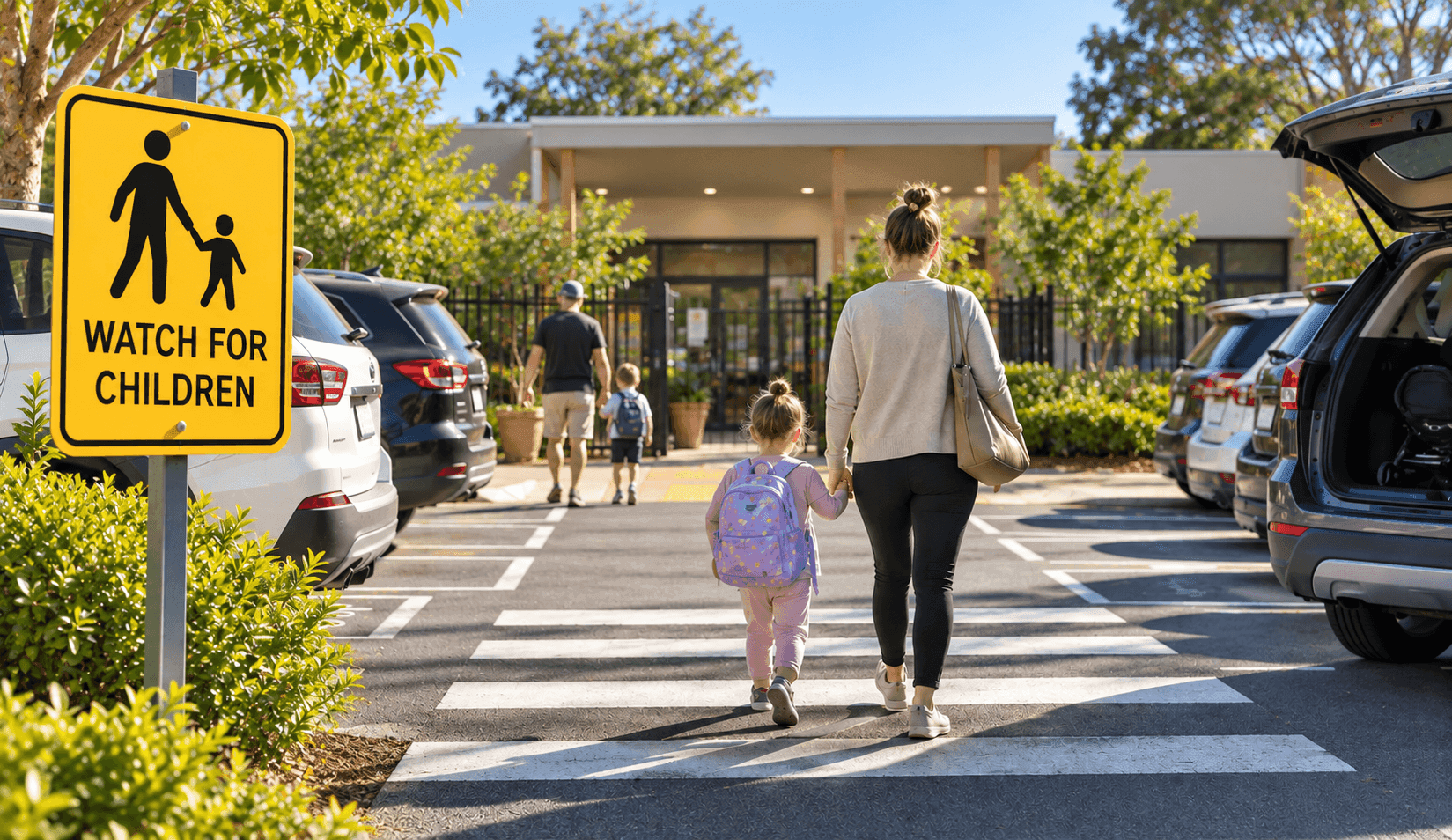
During busy drop-off and pick-up periods, families may be managing young children, siblings, prams, bags and other belongings while moving through an environment shared with vehicles.
Early Learning Association Australia (ELAA) is encouraging services to take a fresh look at what is actually happening in their car parks and consider whether changes are needed to better protect children, families and staff.
Although some car parks have been designed to separate pedestrians and vehicles, others may not have received the same level of safety consideration as environments inside the service.
Car parks bring several hazards together within a relatively confined space:
- Moving and reversing vehicles
- Young children who may be difficult for drivers to see
- Distracted or hurried adults
- Prams, bags and other equipment
- Limited visibility around parked vehicles
- Congestion during peak periods
- Unclear pedestrian routes or crossing points.
A car park may appear manageable outside peak periods but function very differently when multiple families arrive or leave at the same time.
This is why ELAA recommends observing the area during actual drop-off and pick-up periods rather than assessing its safety based solely on its physical design.
A practical review should consider how people and vehicles move through the area and whether everyday behaviours are creating avoidable risks.
Services could ask:
- Are vehicles parked safely and within designated spaces?
- Is there a clearly marked pedestrian route between parked cars and the entrance?
- Can drivers see where children and adults are likely to walk?
- Are there safe crossing points?
- Are children closely supervised by the adult accompanying them?
- Are mobile phones or other distractions affecting awareness?
- Could a child be left unattended in a vehicle?
- Are children travelling in restraints appropriate for their age and size?
- Do fences, vegetation, signage or parked vehicles restrict visibility?
- Would clearer markings, signage or a safety mirror improve the area?
Observations may need to occur across different days, times and weather conditions to provide an accurate picture of how the space is used.
The people who move through the car park each day may notice risks that are easily missed during a formal inspection.
Families and educators can identify concerns involving traffic flow, visibility, parking behaviours and pedestrian access. They may also have practical suggestions based on their experience of using the space.
Children should also be included in age-appropriate conversations. Educators can ask what children notice, where they think it is safest to walk and what could make the area safer.
These discussions recognise children as active participants while strengthening their developing understanding of pedestrian and road safety.
Once hazards have been identified, services can determine which controls are practical and who has the authority to implement them.
Possible improvements might include:
- Creating or clearly identifying a pedestrian route
- Refreshing faded lines or crossing points
- Improving signs and directional markings
- Trimming vegetation that limits visibility
- Installing an appropriately positioned safety mirror
- Reviewing where staff, visitors and families park
- Reinforcing safe arrival and departure expectations
- Addressing unsafe shortcuts between parked vehicles.
Where a service does not own or control the car park, concerns may need to be raised with the property owner, school, council, community organisation or other party responsible for the site.
Shared spaces require consultation so that responsibilities, expectations and proposed changes are clearly understood.
Following any change, the service should review the area again. This helps determine whether the control has reduced the identified risk or unintentionally created a new hazard.
Car park and pedestrian safety expectations can be introduced during family orientation and reinforced through newsletters, enrolment information, signs and respectful conversations.
Messages might remind families to:
- Hold young children’s hands near vehicles
- Avoid mobile phone distractions
- Use identified pedestrian routes
- Park only in designated areas
- Avoid walking behind reversing vehicles
- Ensure children use an appropriate child restraint or booster seat
- Never leave children unattended in a vehicle.
Communication should remain practical and respectful, with the focus placed on the shared responsibility to keep children safe.
The car park can also provide a meaningful context for road safety education.
Educators can discuss how children and adults move safely around vehicles, why visibility matters and how to identify safer places to walk and cross.
Children’s observations can then inform play-based experiences, conversations, drawings, mapping activities and broader road safety learning.
ELAA’s Starting Out Safely program provides additional resources to support road safety education in early childhood settings.
Car parks may sit outside the service entrance, but the risks associated with arrival and departure should not remain outside the service’s safety conversations.
Further information is available in ELAA’s article, What’s Happening in Your Car Park?


Don’t miss a thing




Related Articles