Back to Basics: why early childhood pulled me back

 Article
After more than thirty years working across the early childhood education and care sector, I recently took a short detour into the world of primary education.
Like many people who have spent their careers in early childhood, this sector has always been more than just a job for me. It has shaped who I am professionally and personally.
Over the years I’ve had the privilege of experiencing the sector from just about every angle: educator, centre owner, assessor, mentor, TAFE teacher, and more recently supporting teams across multiple services.
I’ve written policies, supported services through assessment and rating, mentored educators and spent many hours discussing quality practice.
But one thing I’ve learned about early childhood is this:
No matter how far you move into leadership, the sector has a way of bringing you straight back to the floor.
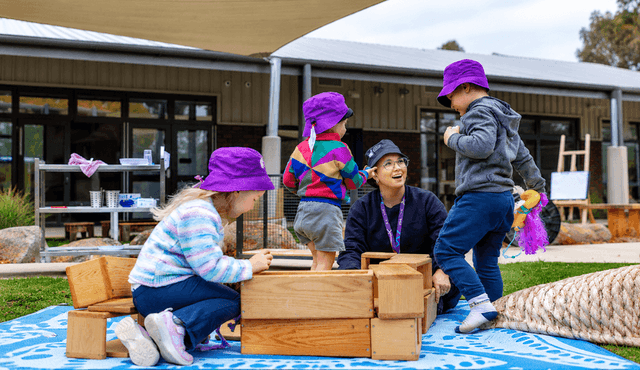
Because one minute you might be reviewing compliance requirements or budgets across multiple centres, and the next you’re covering a lunch break so ratios stay compliant, helping in the kitchen because the cook called in sick, or sitting on the floor building an extremely important block tower with a group of very serious three‑year‑olds.
It keeps you humble.
When I stepped away briefly to work in the primary school environment, I thought I was ready for something different.
But something unexpected happened.
It didn’t quite light me up.
And what surprised me most was how strongly I felt pulled back towards the early years.
In fact, I realised just how much early childhood had shaped the way I see the world.
I remember standing in Coles one afternoon and catching myself watching a toddler exploring the shelves, turning things over, studying the packaging, completely absorbed in the environment around them.
I suddenly realised I wasn’t really shopping anymore.
I was observing.
Thirty years in early childhood will do that to you.
And it made me think about something else.
When you’ve spent that long working closely with children, you come to know them in ways that go far beyond documentation or developmental checklists.
You simply know them.
I remember once picking up a lost jumper at the service, no name on the label, just a small jumper sitting there waiting for its owner.
I gave it a quick sniff and said, “This belongs to Jack.”
And sure enough, it did.
Now before anyone panics, no this is not an official assessment strategy.
But it does say something about early childhood.
When you work closely with children and families every day, you notice the little things, their personalities, their habits, the way they explore their world… and occasionally even the smell of their washing powder.
You know your children.
And that’s something that can’t always be captured in documentation.
Over the years our sector has placed increasing focus on documentation and demonstrating learning. Much of this comes from a genuine desire to improve quality and communicate children’s learning with families.
But sometimes I wonder if we’ve made things more complicated than they need to be.
Because some of the most powerful learning moments don’t happen when an educator is writing about learning.
They happen when an educator is fully present with a child.
Watching.
Listening.
Engaging.
Responding.
Those moments don’t always fit neatly into a template.
Another challenge I’ve observed is how quickly educators are expected to learn the complexity of this profession.
Having taught Certificate III and Diploma students at TAFE, I’ve seen first‑hand how passionate new educators are when they enter the sector. They want to do well and they want to make a difference.
But early childhood is a far more complex profession than many people realise.
Educators are expected to understand curriculum frameworks, manage documentation, maintain regulatory compliance, communicate with families and create engaging environments for children, often while still learning the role themselves.
It’s a reminder that mentoring and supporting educators is one of the most important things we can do as leaders in this sector.
Because great early childhood practice isn’t learned from paperwork.
It’s learned on the floor.
It’s learned through relationships with children.
And it’s learned by working alongside experienced educators who model what quality practice really looks like.
Returning to early childhood reminded me why I fell in love with this sector in the first place.
It’s busy.
It’s messy.
It’s unpredictable.
But it’s also where some of the most important learning in life begins.
And after more than three decades in the sector, I’m still convinced of one thing:
If you really want to understand early childhood education…
Start by sitting on the floor.
Author:
Kellie Burgess has worked in early childhood education for more than 30 years and has experienced the sector from almost every angle, educator, service owner, centre director, assessor, mentor and TAFE trainer for Certificate III and Diploma students. She currently works in early childhood leadership supporting multiple services and remains passionate about strengthening quality practice and supporting educators. Kellie believes the heart of early childhood education lies in truly knowing the children in our care and never losing sight of why we came into this profession in the first place.


Don’t miss a thing




Related Articles