Queensland regulatory data shows growth in approved places as service mix shifts across ECEC

 Article
The Queensland Early Childhood Education and Care Regulatory Authority has released its latest quarterly regulatory data, offering a detailed snapshot of service growth, monitoring activity, compliance trends and changing service patterns across the state’s early childhood education and care (ECEC) sector.
The figures, current to 31 March 2026, show a sector that continues to expand while operating within an increasingly active regulatory environment.
According to the Regulatory Authority, publishing regulatory data supports transparency, encourages voluntary compliance and promotes continuous quality improvement across Queensland’s ECEC sector.
Approved services continue to grow across Queensland
As at 31 March 2026, Queensland had 3,371 approved ECEC services, representing a 0.6 per cent increase compared with the same period last year.
This includes:
- 3,329 services approved under the National Quality Framework (NQF)
- 42 services approved under the Education and Care Services Act 2013
- 269,746 approved centre-based places, an increase of 2.7 per cent year-on-year.
While overall growth across the sector remained relatively steady, the latest data highlights changing patterns across different service types.
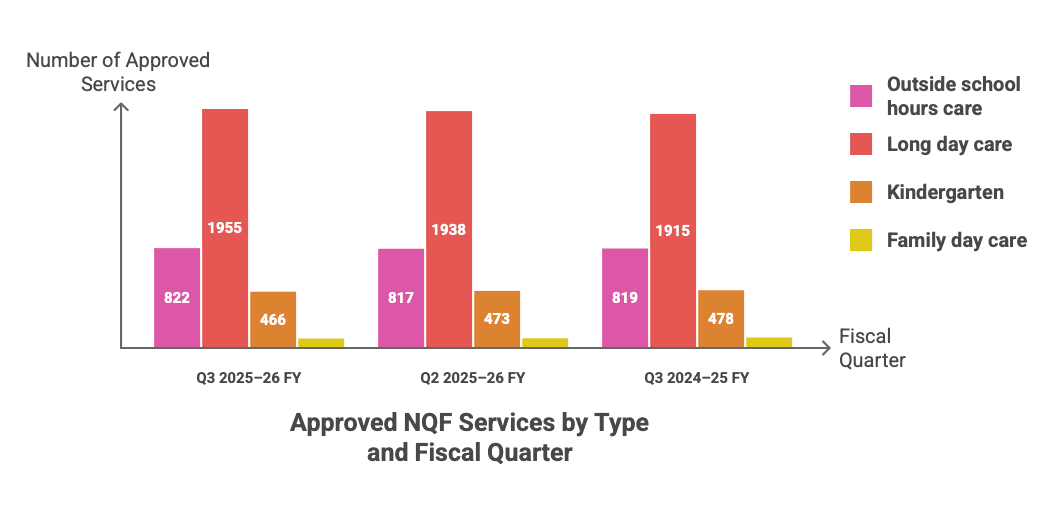
Long day care growth continues while family day care declines
The Queensland Regulatory Authority’s latest figures show long day care continues to dominate sector growth, while family day care and kindergarten service numbers have declined over the past 12 months.
Approved NQF services by type
Applications decrease compared with same quarter last year
The latest data also shows a notable decrease in the number of applications received by the Regulatory Authority.
In Quarter 3 of the 2025–26 financial year, the Authority received 368 applications across a range of categories, down from 610 in the same quarter last financial year, representing a 39.7 per cent decrease.
Applications received by type
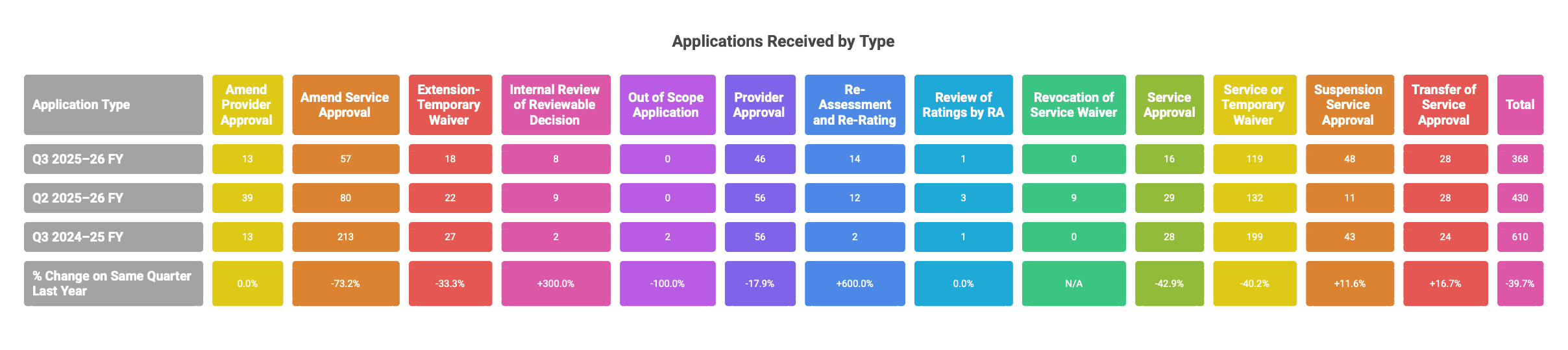
The largest decreases were recorded in amend service approval applications and service or temporary waiver applications.
Re-assessment and re-rating applications increased from two in the same quarter last financial year to 14 this quarter, while internal review applications also increased from two to eight.
For approved providers, the application data offers useful insight into regulatory activity beyond service numbers alone, including how providers are engaging with approval changes, waivers, transfers, reviews and rating processes.
Assessment and rating activity remains steady overall
The data also shows the number and type of assessment and ratings completed by the Regulatory Authority during Quarter 3 of the 2025–26 financial year.
A total of 182 assessment and rating visits were completed during the quarter, compared with 183 in the same quarter last financial year.
NQF services assessed and rated
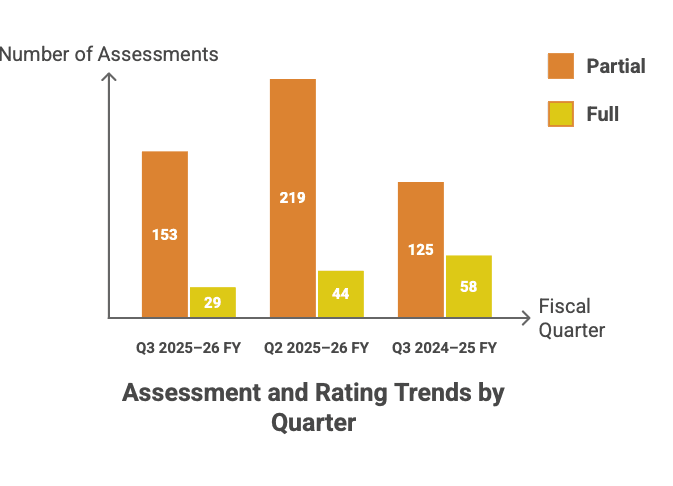
While the total number of assessments and ratings completed was broadly consistent with the same quarter last year, the composition shifted.
Full assessment and rating activity decreased by 50 per cent, while partial assessment and rating activity increased by 22.4 per cent.
This suggests a continued focus on targeted assessment activity, with partial assessment and rating forming a larger share of the Authority’s assessment work during the quarter.
In a small number of cases, approved providers may apply for a first tier review of a quality rating issued by the Regulatory Authority. The Queensland Regulatory Authority also publishes first tier review outcome data as part of its quarterly reporting, providing further transparency around rating review processes.
Most Queensland services are meeting or exceeding the NQS
The latest data shows the majority of rated Queensland ECEC services continue to hold a quality rating of Meeting the National Quality Standard (NQS) or above.
The data also shows that 95 per cent of Queensland services have been assessed and rated, compared with 94 per cent nationally.
As at 31 March 2026, the proportion of services meeting or exceeding the NQS had increased across all major service types compared with the same quarter last financial year.
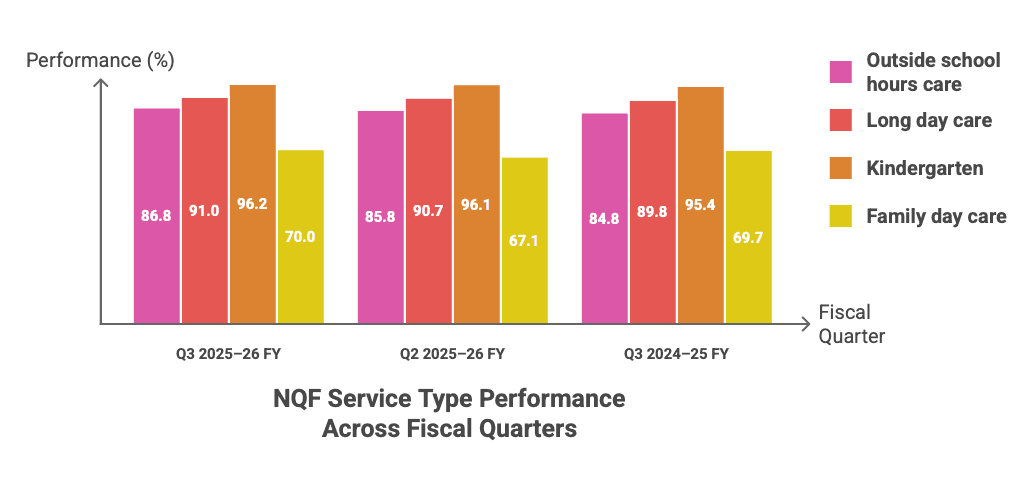
Kindergarten services recorded the highest proportion of services meeting or exceeding the NQS at 96.2 per cent, followed by long day care at 91.0 per cent.
Outside school hours care recorded the largest year-on-year increase, rising by 1.9 percentage points.
Number and percentage of services by quality rating
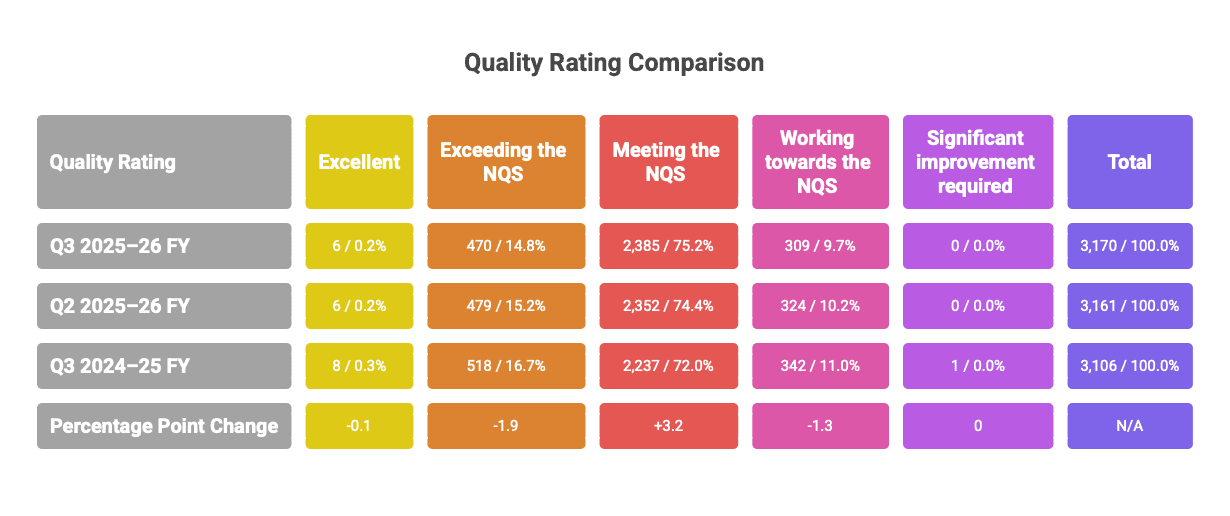
The rating distribution shows an increase in the proportion of services rated Meeting the NQS, rising from 72.0 per cent in Q3 2024–25 to 75.2 per cent in Q3 2025–26.
The proportion of services rated Working Towards the NQS declined from 11.0 per cent to 9.7 per cent over the same period.
While the percentage of services rated Exceeding the NQS decreased slightly, the overall proportion of services rated Meeting or above improved across each major service type.
More than 1,000 monitoring visits conducted in Q3
The latest data also provides insight into the scale of proactive regulatory oversight occurring across Queensland services.
The Regulatory Authority conducted 1,038 monitoring visits during Quarter 3 of the 2025–26 financial year. These visits may be announced or unannounced and are designed to assess compliance with legislative requirements and support continuous improvement across services.
The figures do not include visits conducted as part of investigations or in response to notifications and complaints.
Monitoring visits conducted by the Regulatory Authority
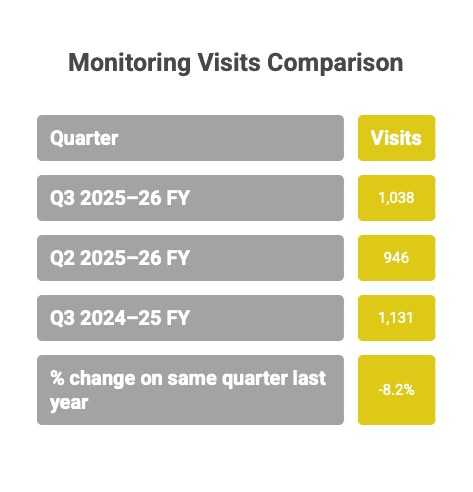
While monitoring visits were lower than the same quarter last year, activity increased compared with the previous quarter, suggesting continued regulatory focus across the sector.
The data also reinforces the ongoing shift toward risk-based regulatory monitoring, with proactive visits continuing to form a key part of the Regulatory Authority’s oversight approach.
Compliance actions highlight ongoing regulatory focus
The latest quarterly data also provides insight into the number and type of statutory compliance actions taken by the Regulatory Authority during Quarter 3 of the 2025–26 financial year.
A total of 177 compliance actions were issued during the quarter, down from 211 in the same quarter last financial year, representing a 16.1 per cent decrease overall.
Compliance actions taken
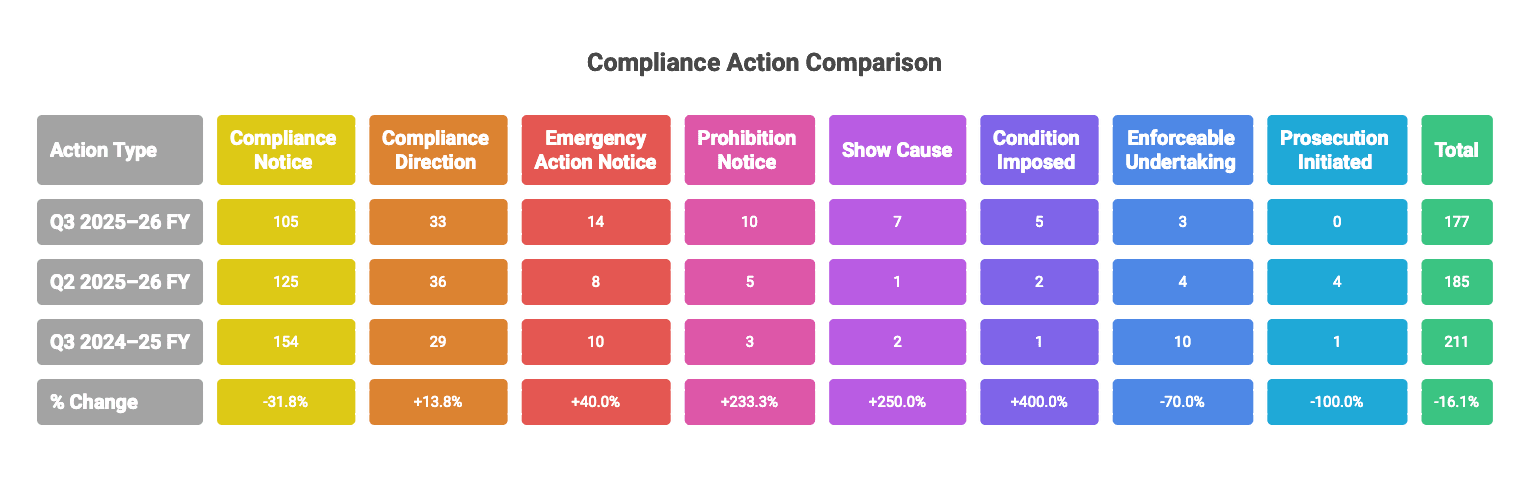
While overall compliance actions declined compared with the same quarter last year, several higher-level enforcement actions increased, including emergency action notices, prohibition notices and show cause actions.
The data reflects the breadth of regulatory responses available to the Authority, ranging from compliance notices and directions through to emergency actions and prohibition notices where more serious concerns are identified.
Supervision remains the most common National Law breach
In Q3 2025–26, the most common National Law breach was s.165, relating to inadequate supervision of children, with 222 breaches recorded.
Top 5 breaches of the National Law
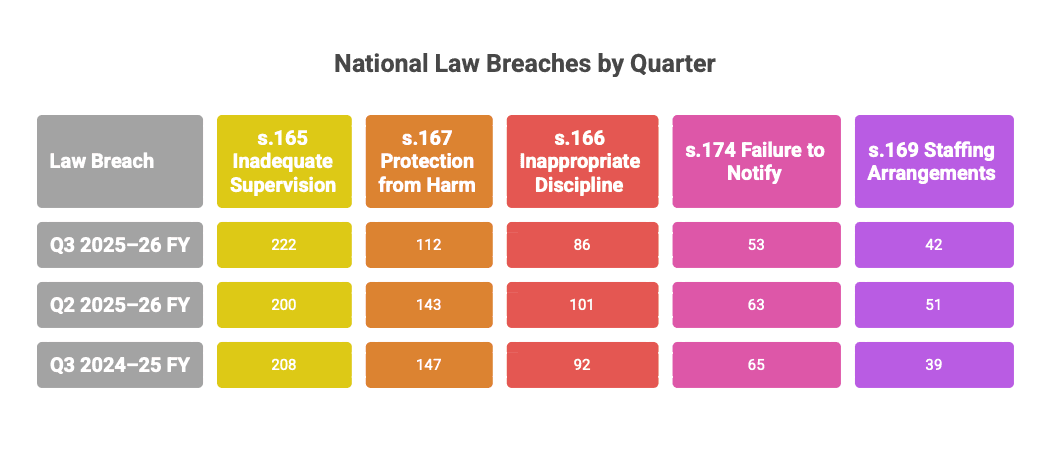
The data shows supervision remains a key regulatory concern, with inadequate supervision breaches increasing year-on-year.
Premises safety leads National Regulations breaches
Under the National Regulations, r.103, relating to premises, furniture and equipment being safe, clean and in good repair, was the most common breach in Q3 2025–26.
Top 5 breaches of the National Regulations
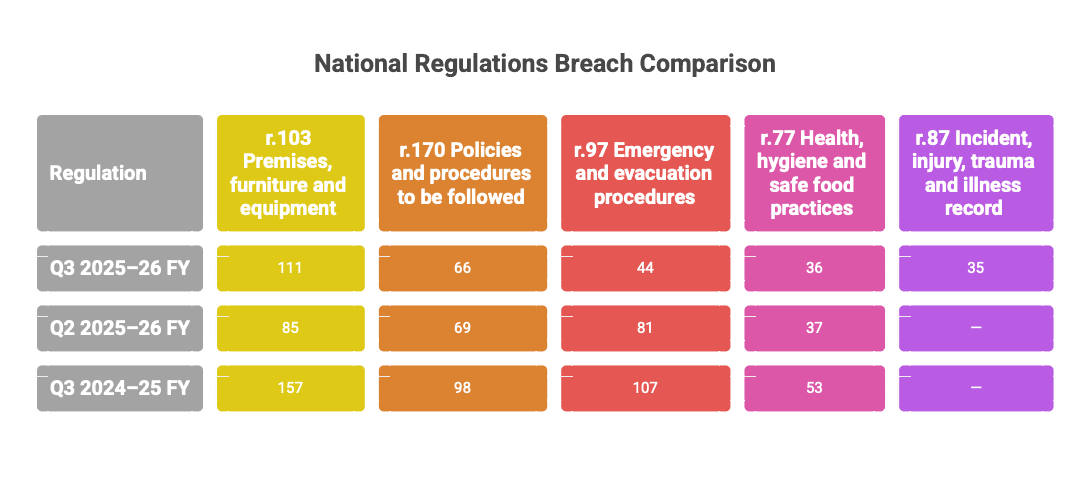
The data reinforces that supervision, hazard management, staffing arrangements, policy implementation, premises safety and documentation remain core compliance priorities across the Queensland sector.
Direct complaints to the Regulatory Authority increase
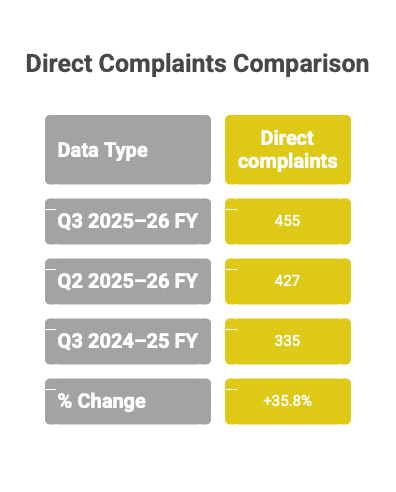
The data also shows an increase in complaints made directly to the Regulatory Authority.
In Q3 2025–26, 455 complaints were made directly to the Authority, compared with 335 in the same quarter last financial year — a 35.8 per cent increase year-on-year.
Complaints made directly to the Regulatory Authority
The increase may reflect stronger reporting expectations, increased public awareness and broader community focus on child safety and service quality.
Notifications of incidents and complaints decrease, with weather closures impacting earlier data
The Regulatory Authority received 3,076 notifications of incident or complaint in Q3 2025–26.
Notifications of incident or complaint
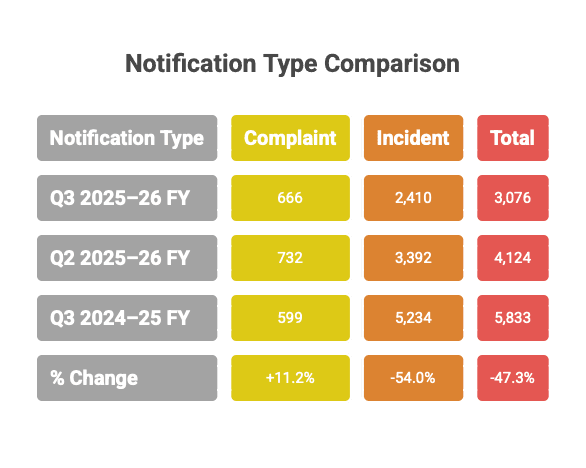
*The Regulatory Authority notes that there were a large number of service closures caused by severe weather in November 2025 and March 2025, which impacted earlier notification figures.
While total notifications decreased significantly year-on-year, complaint notifications increased by 11.2 per cent.
The weather-related closures provide important context when interpreting the reduction in incident notifications across quarters.
A sector continuing to evolve
Queensland’s latest regulatory data paints a picture of a sector that continues to grow and adapt while operating under active regulatory oversight.
With increasing approved places, shifting service patterns, evolving quality outcomes and continued compliance activity, the data highlights both the scale of the sector and the complexity of operating within today’s ECEC environment.
For Approved Providers, Nominated Supervisors, boards and operational leaders, remaining informed about regulatory trends is increasingly part of effective governance, compliance oversight and long-term sustainability planning.
Access the full Queensland Regulatory Authority data here: Queensland Regulatory Data


Don’t miss a thing




Related Articles