



Same framework, different conditions: why quality in OSHC needs its own language
 Article
When Australia talks about quality in early childhood education and care, the conversation often centres on long day care and preschool/kindergarten. These settings are critical, of course. But they are not the whole story.
Every week, children also move into Outside School Hours Care, before school, after school, on pupil-free days and during school holidays. They arrive with full school days behind them, friendships to navigate, energy to release, ideas to explore, and a need for both connection and rest. For many families, OSHC is not an optional extra. It is a vital part of daily life.
Yet OSHC is still too often treated as if it sits at the edge of the early childhood education and care conversation. That is worth questioning, because OSHC is not outside Australia’s quality system. It sits within the National Quality Framework, is assessed against the National Quality Standard, and uses a nationally approved learning framework: My Time, Our Place.
The issue, then, is not whether OSHC belongs in the quality conversation. It already does. The more important question is whether quality conversations in Australia give OSHC enough visibility, enough nuance and enough recognition as a distinct school-age care context. Language matters because it shapes what we notice, value and support. When quality is described mainly through early-years examples, OSHC educators and leaders are often left to translate those ideas into a very different practice environment.
Same national framework, different conditions
OSHC shares important foundations with other education and care settings. Like long day care, preschool/kindergarten and family day care, OSHC operates within the National Quality Framework. Services are assessed against the National Quality Standard, and educators are expected to engage with children’s learning, wellbeing, relationships and agency.
But shared standards do not mean identical practice.
In early childhood settings, the rhythm of the day is often shaped around longer periods of care, routines, rest, meals, play, intentional teaching and relationships with very young children. In OSHC, the conditions are different. Sessions are shorter. Attendance can change from day to day. Groups are often large and mixed-age. Educators work with children who have already spent many hours at school. Programs are shaped around leisure, recreation, choice, relationships, transitions and children’s right to decompress as well as participate.
These differences matter.
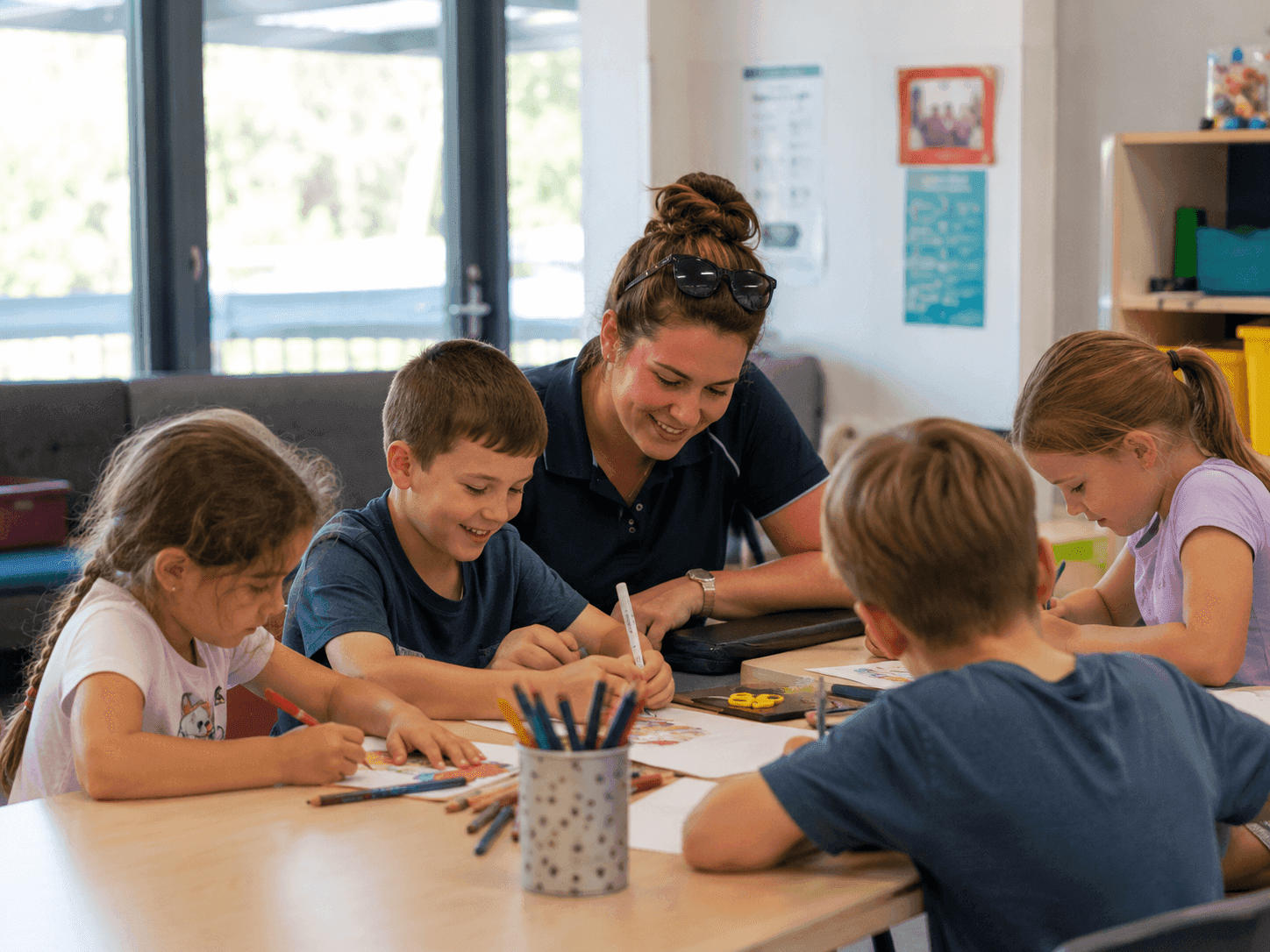
Quality in OSHC does not always look like quality in a preschool room or a long day care environment. It may look like a child having genuine choice after a structured school day. It may look like a group of older children negotiating a game with younger children. It may look like educators supporting friendships, inclusion and belonging in a fast-moving afternoon session. It may look like a calm transition from school to care, where children feel known, safe and welcomed. It may look like intentionality within leisure, not instead of it.
This is why My Time, Our Place is so important. It gives language to school-age care. It recognises play, leisure, intentionality, collaboration, wellbeing, agency and partnerships. It reminds us that OSHC is not simply “early childhood with older children”, but a pedagogical setting with its own rhythm, strengths and complexities.
OSHC is not a small part of the system
OSHC is sometimes discussed as if it is peripheral to education and care reform. The data tells a different story.
Recent national reporting shows OSHC represents a significant proportion of approved services and supports hundreds of thousands of children. The Productivity Commission has also noted that around one in seven children aged 5–12 attend outside school hours care. That scale should matter in national conversations about quality, workforce, affordability, access, inclusion and child wellbeing.
If quality reform is primarily imagined through the lens of birth-to-five settings, then a large part of children’s everyday education and care experience risks being under-contextualised. This is not about diminishing the importance of the early years. It is about recognising that children’s lives do not stop being shaped by relationships, environments and pedagogy when they start school.
School-age children still need places where they can belong, contribute, play, rest, take appropriate risks, build friendships and be heard. OSHC provides those opportunities, often in the pressured spaces between school, work and family life.
OSHC quality needs OSHC-shaped support
One of the challenges for OSHC is that many quality improvement conversations are built from assumptions that do not always transfer neatly into school-age care.
Professional learning designed for long day care may not fit the pace, staffing structure or sessional nature of OSHC.
Educational leadership expectations may be difficult to enact when leaders are also managing enrolments, ratios, family communication, staff changes, transitions, compliance, school relationships and daily operational pressures.
Curriculum conversations may miss the importance of leisure, child-led decision-making and mixed-age social worlds.
The OSHC workforce is also distinct. It includes educators with a wide range of qualifications, experience levels and career intentions. In many services, staffing is
casualised, younger and more transient than in other parts of the sector. That does not mean OSHC educators are less capable or less committed. It means the sector needs professional learning, leadership development and policy settings that reflect the actual conditions in which OSHC educators work.Quality improvement is strongest when it is realistic, relational and context-aware.
For OSHC, that means recognising that educators are often making rapid professional judgements in short windows of time: supporting children through transitions, responding to complex social and emotional moments, creating inclusive play opportunities, managing risk, engaging children’s voices, and building relationships with families and schools.
That work deserves to be named as educational work.
What OSHC can contribute to the wider ECEC conversation
OSHC should not only be included in quality conversations because it needs recognition. It should be included because it has something valuable to contribute.
OSHC has deep practice knowledge in mixed-age pedagogy, child agency, leisure-based learning, transitions, community connection and responsive programming. It works with children who can articulate their preferences, critique their environments, lead projects, mentor younger peers and negotiate complex social relationships. It offers a powerful view of children as active citizens, not just future learners.
In a national context where children’s voice, wellbeing, inclusion and agency are increasingly important, OSHC has much to offer.
The OSHC sector also understands the importance of relationships beyond the service walls.
OSHC quality is often shaped by partnerships with schools, families, community organisations and children themselves. A strong OSHC service does not simply supervise children between one part of the day and another. It creates continuity, belonging and possibility in a space that can otherwise be overlooked.
Where to from here?
For policymakers, this means ensuring OSHC is visible in quality reform, workforce planning and child wellbeing conversations, not as an afterthought, but as part of the system. For sector leaders, it means asking whether professional learning, educational leadership support and quality improvement tools are genuinely fit for OSHC conditions.
For researchers, it means continuing to build a stronger evidence base around school-age care, including educational leadership, pedagogy, workforce development and children’s experiences in OSHC.
For the broader ECEC sector, it means resisting the temptation to treat quality as if it looks the same in every setting. Shared standards matter. But so does context.
Including OSHC more deliberately in Australia’s ECEC quality conversation is not about collapsing the differences between early childhood and school-age care. It is about recognising that a national quality system is strongest when all parts of that system are visible, understood and valued.OSHC is already in the system.
Now it needs to be more fully in the story.
Author
Belinda Wright is an Australian OSHC practitioner-researcher, instructional designer and sector leader with extensive experience across Outside School Hours Care, educator capability development and service leadership. She is the Founder and Director of Learning at Learn OSHC. Belinda is currently completing postgraduate study in education, leadership and research, with emerging research interests in educational leadership, workforce capability and quality practice in Australian OSHC contexts.


Don’t miss a thing




Related Articles