Preschool attendance in 2025: what new ABS data reveals about participation, equity and system design

 Article
The latest release from the Australian Bureau of Statistics provides a clearer national picture of preschool participation, highlighting persistent equity gaps and structural challenges shaping the future of universal access.
Australia’s preschool participation data for 2025 offers important insight into how children are engaging with early learning in the year before school, and where systemic barriers remain.
The latest release from the Australian Bureau of Statistics (ABS), Preschool Attendance, 2025, provides the most comprehensive national dataset currently available. While classified as experimental, the data offers a reliable directional view of enrolment, attendance patterns and equity outcomes across the early childhood education and care (ECEC) system.
The ABS reports 263,519 children attending preschool in 2025, with 72 per cent (188,808 children) meeting the 600-hour annual benchmark.
This benchmark remains the primary policy measure used by governments to assess whether children receive sufficient preschool exposure prior to starting school.
While overall participation remains stable, the data reveals significant variation beneath the national figure, particularly across service types and population groups.
Two priority groups continue to record lower rates of benchmark attainment:
- Aboriginal and Torres Strait Islander children: 17,642 enrolled, with 58 per cent meeting the benchmark
- children in the most disadvantaged areas: 47,278 enrolled, with 63 per cent meeting the benchmark
These disparities reflect long-standing structural barriers, including workforce shortages, transport limitations, geographic access challenges and restricted operating hours in some service models.
The findings reinforce the need for targeted, place-based strategies and culturally responsive approaches to improve participation and outcomes.
The ABS data highlights significant differences in attendance outcomes depending on service type:
- centre-based day care only: 64 per cent of children, with 82 per cent meeting the benchmark
- preschool only: 23 per cent of children, with 31 per cent meeting the benchmark
- both service types: 12 per cent of children, with 97 per cent meeting the benchmark
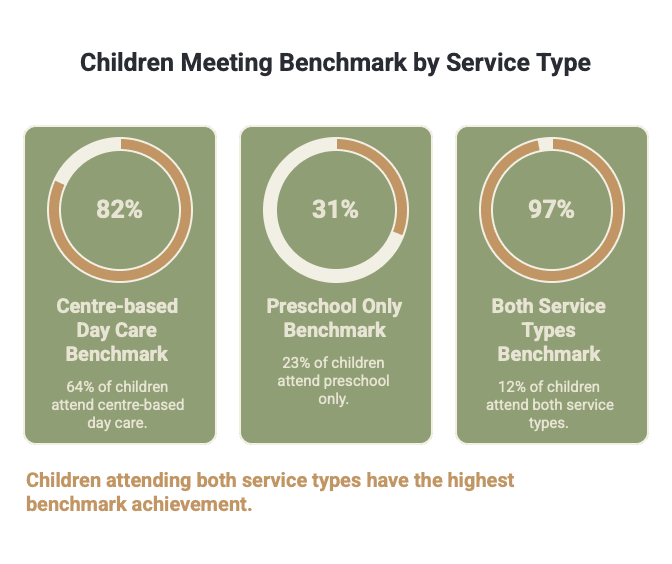
These results point to a structural constraint within the system. Sessional preschool models, which often operate with limited hours and flexibility, can make it difficult for families to reach the 600-hour threshold.
By contrast, integrated or mixed-delivery models provide greater continuity and access, resulting in significantly higher participation rates.
For policymakers and providers, this raises important questions about the long-term role of standalone preschool programs and whether funding and delivery settings require reform to support equitable access.
The ABS classifies the dataset as experimental, noting that not all providers were able to supply complete data for this collection cycle.
This has implications for governance and sector planning. While the dataset provides valuable insight, it should be interpreted alongside other sources, including state-based collections and longitudinal data.
For boards and leadership teams, the data is best used as a directional indicator rather than a definitive national measure, particularly when informing workforce planning, service delivery and risk management.
Several key themes emerge from the 2025 data:
- equity gaps require targeted, place-based responses rather than uniform national settings
- sessional preschool models face structural limitations in meeting participation benchmarks
- integrated service delivery models support stronger attendance outcomes
- workforce availability and operating hours remain critical enablers of participation
- data completeness continues to be a governance consideration for the sector
These findings arrive at a critical point, as governments continue to refine universal preschool policy settings and participation targets.
The 2025 ABS data reinforces a central challenge for the ECEC sector: ensuring all children can access sufficient, high-quality preschool experiences before school entry.
Addressing this challenge will require alignment across funding, workforce, infrastructure and service delivery models.
As future data collections improve in completeness and consistency, they will play an increasingly important role in shaping policy decisions and sector strategy.
Reference:
Australian Bureau of Statistics, Preschool Attendance, 2025.


Don’t miss a thing




Related Articles