



More child care services meeting National Quality Standard as sector reaches record high

 Article
New national data shows an increase in the number of early childhood education and care (ECEC) services meeting or exceeding the National Quality Standard (NQS), with overall performance reaching its highest level since the framework was introduced in 2013.
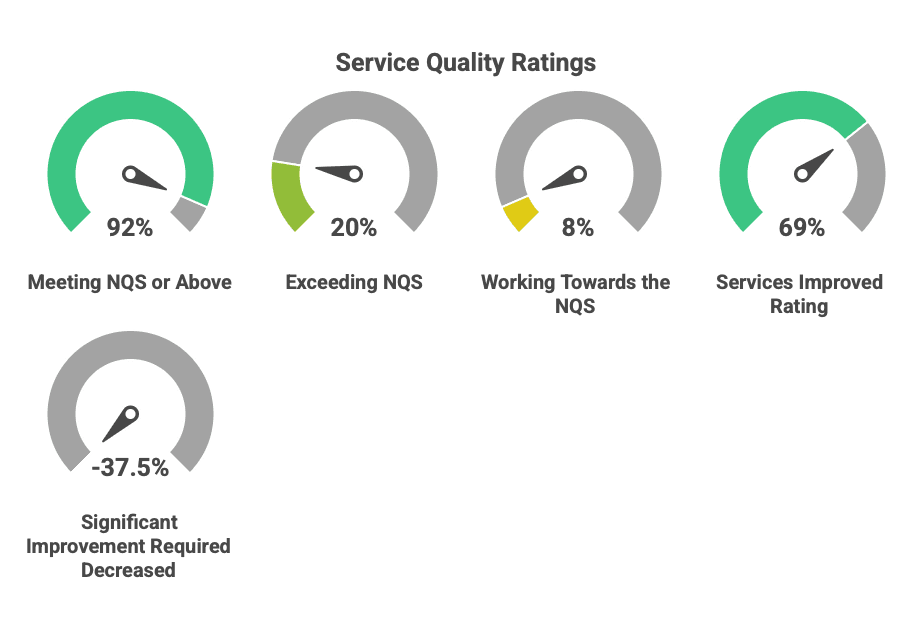
According to the latest figures released by the Australian Children’s Education and Care Quality Authority (ACECQA) in its Q4 2025 NQF Snapshot, 92 per cent of services are now rated as Meeting the NQS or above. When the current Government came to office, that figure stood at 88 per cent.
In addition, 94 per cent of services now hold a quality rating, compared with 90 per cent in 2022.
The National Quality Standard forms part of the National Quality Framework (NQF) and sets the national benchmark for the quality of education and care services across Australia.
As of 1 January 2026, there were 18,027 education and care services approved to operate under the NQF.
The sector remains overwhelmingly centre-based, with long day care and preschool services accounting for 98 per cent, 17,639 services. Family day care represents 2 per cent, 388 services, reflecting a 7 per cent decline in FDC services over the past year.
There are 7,220 approved providers nationally. The majority, 78 per cent, operate a single service. Large providers, those operating 25 or more services, represent just 1 per cent of providers but operate 36 per cent of all approved services.
Of the 16,911 services with a quality rating:
- 92 per cent (15,532 services) are rated Meeting NQS or above
- 20 per cent (3,301 services) are rated Exceeding NQS
- 26 services hold the Excellent rating, the highest accolade awarded by ACECQA
Only 8 per cent of services are currently rated Working Towards the NQS, and five services nationally are rated Significant Improvement Required.
Encouragingly, in the most recent quarter, 69 per cent of services previously rated Working Towards improved their rating upon reassessment. The number of services rated Significant Improvement Required decreased by 37.5 per cent over the same period.
The Snapshot reveals notable variation across service types.
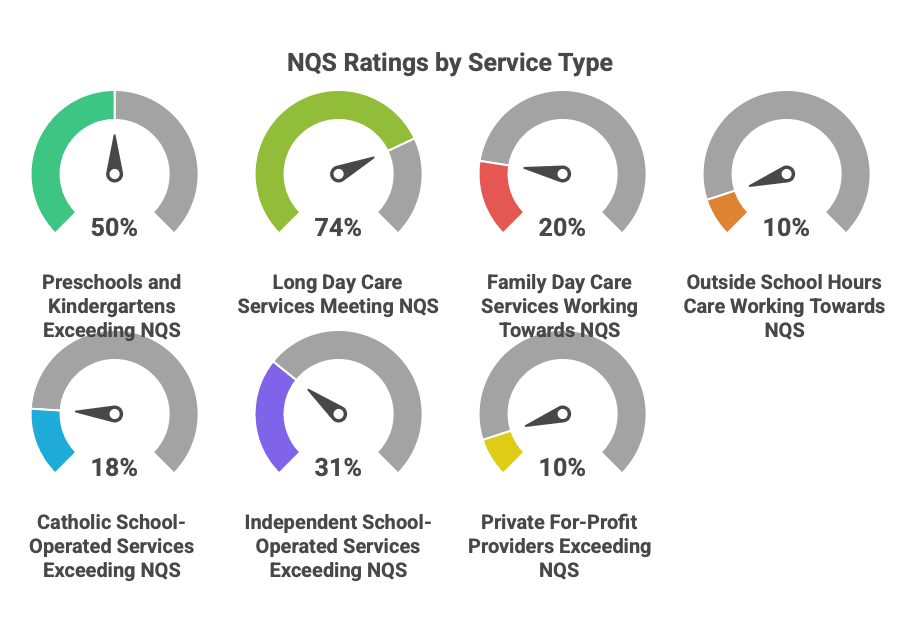
Preschools and kindergartens are the strongest performers, with 50 per cent rated Exceeding NQS and only 3 per cent rated Working Towards.
Long day care services show solid performance, with 74 per cent rated Meeting NQS and 17 per cent rated Exceeding.
Family day care services face greater challenges, with 20 per cent rated Working Towards NQS, the highest proportion among service types.
Outside school hours care services sit between these benchmarks, with 10 per cent rated Working Towards and 6 per cent rated Exceeding.
Management structure also influences outcomes. Catholic and Independent school-operated services record higher proportions of Exceeding ratings, 18 per cent and 31 per cent respectively), while private for-profit providers, which make up 54 per cent of the sector, have 10 per cent of services rated Exceeding NQS.
The NQS assesses services across seven quality areas, including educational program and practice, children’s health and safety, staffing arrangements, and governance and leadership.
The strongest performing areas nationally are:
- Quality Area 6 Collaborative partnerships with families and communities
- Quality Area 5 Relationships with children
Quality Area 6 records the highest number of Exceeding ratings and the lowest proportion of Working Towards outcomes (1 per cent).
More challenging areas include:
- Quality Area 7 Governance and leadership
- Quality Area 2 Children’s health and safety
At element level, the most frequently Not Met requirements include:
- 1.3.2 Critical reflection
- 1.3.1 Assessment and planning cycle
- 7.1.2 Management systems
These findings highlight ongoing opportunities for improvement in educational programming and governance systems.
The data also shows an increase in regulatory activity.
Regulator visits to services rose by 15.2 per cent year on year, while assessment and rating visits increased by 4.5 per cent.
For every assessment and rating visit, regulatory authorities conduct approximately four additional visits, including compliance monitoring and complaint investigations. When statutory action is required, the most common response is a compliance notice, followed by a compliance direction.
Education Ministers have agreed to more regular assessment and rating cycles. Under the updated approach, services will be assessed on average every three years, with more frequent visits for those rated Working Towards the NQS.
Compliance action has also intensified at the Commonwealth level. Laws introduced in 2025 allow the Australian Government to suspend, cancel or place conditions on a service’s Child Care Subsidy approval if it fails to meet the NQS.
The Department of Education has initiated compliance action against more than 60 ECEC services under these strengthened powers.
The Q4 2025 NQF Snapshot paints the picture of a mature sector, with 92 per cent of services now meeting or exceeding national standards.
While governance, educational programming and family day care remain areas requiring continued attention, the high rate of improvement upon reassessment suggests the NQF continues to drive quality uplift.
For approved providers and service leaders, the message is clear: sustained internal review, strong governance systems and readiness for assessment remain critical as regulatory scrutiny increases.
Quality improvement is no longer episodic.
It is continuous.


Don’t miss a thing



Related Articles