Mixed-age grouping is more than a challenge: When different ages share the afternoon
Part 2 of this five-part series, Participation in the Shared Life of OSHC, explores why mixed-age grouping is more than a challenge, considering what becomes possible when different ages share the afternoon.
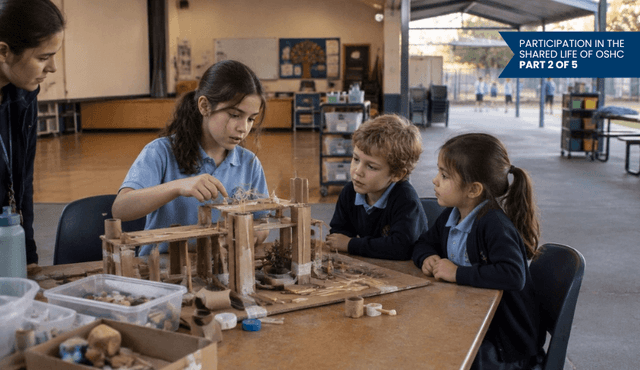
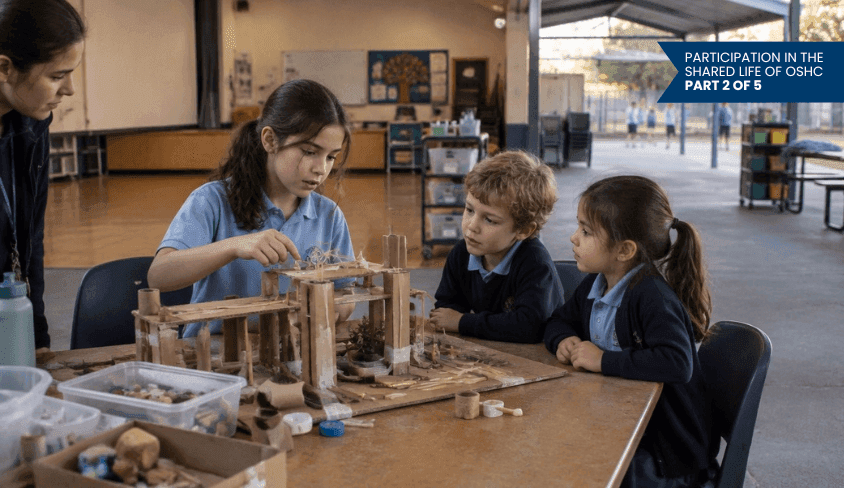
A familiar mixed-age tension might look like this. An eleven-year-old has spent several afternoons building a model. Two younger children pull up chairs and reach for the materials. She moves the work closer and explains that it is fragile and she wants to finish it herself. The educator now faces a question that cannot be settled by a general rule about sharing.
Mixed-age grouping is often introduced as an OSHC challenge: planning for different interests, keeping older children engaged, preventing younger children from being excluded and sharing spaces fairly. Those pressures are real. They can also pull our attention away from what children are working out with one another.
OSHC routinely brings children in their first year of school into a shared afternoon with children approaching secondary school. Age can shape access, influence and the way behaviour is interpreted, though not in predictable ways. The oldest child in a group may withdraw rather than lead. The idea that changes an activity may come from a much younger child.
I am interested in how age shapes these encounters. Whose judgement carries weight, and who is expected to make room? Mixed-age grouping creates possibilities, but children do not experience them in the same way.
Age is already organising the room
Children arrive at OSHC with ideas about what older and younger children are like, what each group should be allowed to do and who belongs where. Adults bring assumptions too. We may read confidence as maturity, physical size as capability or age as a reason to trust one child’s judgement more readily than another’s.
Chronological age matters, particularly when educators are thinking about safety and risk. It is still a blunt guide to competence or to how a child prefers to participate. An older child who is new to the service may have less influence than a younger child who knows its people, routines and history.
This is why I find “catering for all ages” too thin an ambition. Separate offerings may broaden the program, but they tell us little about what happens to influence once children come together.
Who gets a say once everyone joins
A younger newcomer may be welcome to watch and still have little say in what happens. A general expectation that everything must be shared can also deny another child ownership of work that matters to them.
Play and leisure make this especially visible because much of the negotiation happens between children. ACECQA’s guidance on play, leisure and intentionality recognises that children and young people create social groups, build relationships and challenge one another’s thinking through play. For educators, that invites attention to the social life of the activity as well as its content. The same absorbing experience may involve gatekeeping or leave some children with little influence.
For the educator standing beside the model, the presence of several ages tells only part of the story. How did the younger children try to enter? Whose rules are shaping the activity, and does the older child have any say over work she has sustained for days? Sometimes the group needs an educator to name the rules already operating. There is also a risk in entering too quickly and settling a negotiation the children were capable of carrying themselves.
Access will look uneven across a real afternoon. The pattern to notice is whether the same children repeatedly have to surrender influence in order to remain included.
Connection cannot be assigned
Mixed-age OSHC brings together children who would usually be separated in a same-year classroom. Friendships may grow around a shared interest or a long-running project. Children also see that expertise does not always sit with the oldest person in the group.
It is easy to tell a warm story about older children naturally mentoring younger ones. In practice, cross-age connection may be welcome in one moment and tiring in the next. Older children can reasonably want time with peers close to their own age. Positioning younger children as permanent recipients of help also overlooks what they know and contribute.
My Time, Our Place V2.0 describes relationships as central to school age care. ACECQA’s collaboration guidance directs attention to shared decisions, respect and trust. In a mixed-age setting, I read this as room for connection across ages and for time apart. Neither should become an obligation.
When older becomes a job description
Responsibility makes these assumptions especially visible. An older child may genuinely enjoy showing a younger child how to use equipment, helping with a game or looking out for a sibling. The difficulty begins when “older” quietly becomes a job description: explain the rules, tolerate interruption, model appropriate behaviour and show more maturity whenever conflict occurs.
In a small Australian qualitative study, Bruce Hurst used the term “apprentice educator” for a helping role in which older children were offered adult-like responsibilities. The idea leaves me asking whether the child chose that responsibility or whether it quietly arrived with age.
An older child who enjoys helping on Tuesday may want to be absorbed in their own play on Wednesday. Capability does not create an ongoing obligation. Younger children also need room to be knowledgeable and influential without their contribution being treated as unusually advanced.
These patterns can sit inside ordinary requests: the older child asked again to help settle a game, or the younger child’s objection dismissed as immaturity. Protection can narrow what younger children are permitted to do. The assumption that older children “should know better” can leave them carrying more of a conflict than is fair.
Room to be more than an age
Back at the model, the younger children’s interest in joining matters, and so does the older child’s wish to protect her work. The educator can acknowledge both positions and help them work out whether another kind of joining is possible.
Mixed-age life in OSHC can hold real connection, while age still quietly settles who makes room or whose judgement is trusted. Alongside “How do we manage all these ages?” sits a more precise question: what assumption about age is already shaping this moment?
In the next article, Does Rest Need Permission?, I turn to quieter ways of participating. When a child watches, withdraws or chooses not to join, what are we recognising, and what might we be trying to move them towards?
Author
Belinda Wright is an Australian OSHC practitioner-researcher, instructional designer and sector leader with extensive experience across Outside School Hours Care, educator capability development and professional learning. She is the Founder and Director of Learning at Learn OSHC and a PhD Candidate, with doctoral research focused on Outside School Hours Care and educational leadership in Australian school-age care contexts.


Don’t miss a thing




Related Articles