Major institutional investors reduce stakes in G8 Education
 Article
Several major institutional investors have recently reduced their shareholdings in G8 Education Limited, with new regulatory filings showing a number of large funds either dropping below the “substantial holder” threshold or significantly reducing their voting power.
The disclosures, lodged under the Corporations Act 2001, were submitted in late February and early March 2026 and provide insight into changing investment positions in one of Australia’s largest for-profit early childhood education and care (ECEC) providers.
Under Australian corporate law, an investor is considered a substantial holder when they control 5 per cent or more of a company’s voting shares.
If an investor’s stake falls below that threshold, they are required to lodge a Form 605: Notice of ceasing to be a substantial holder. When an existing substantial holder significantly alters their voting power, they must lodge a Form 604: Notice of change of interests of substantial holder.
Recent filings relating to G8 Education show several large investors adjusting their positions over a short period.
Global investment firm The Vanguard Group has ceased to be a substantial holder in G8 Education after its voting power fell below the 5 per cent threshold.
The change followed a series of share transactions across 2023 and 2024 that gradually reduced the firm’s position.
Australian industry superannuation fund Hostplus Pty Limited also ceased to be a substantial holder in G8 Education.
Investment manager Dimensional Fund Advisors LP, operating through a group of related entities, similarly lodged a notice confirming it had ceased to be a substantial holder.
Unlike the other investors, Macquarie Group Limited remains a substantial holder in G8 Education, although its stake has declined.
A notice lodged in March shows Macquarie’s voting power falling from 8.83 per cent to 7.21 per cent, representing a reduction of more than 12 million shares.
Changes in institutional shareholdings do not necessarily reflect operational performance or strategic direction, but they can provide insight into broader capital allocation trends.
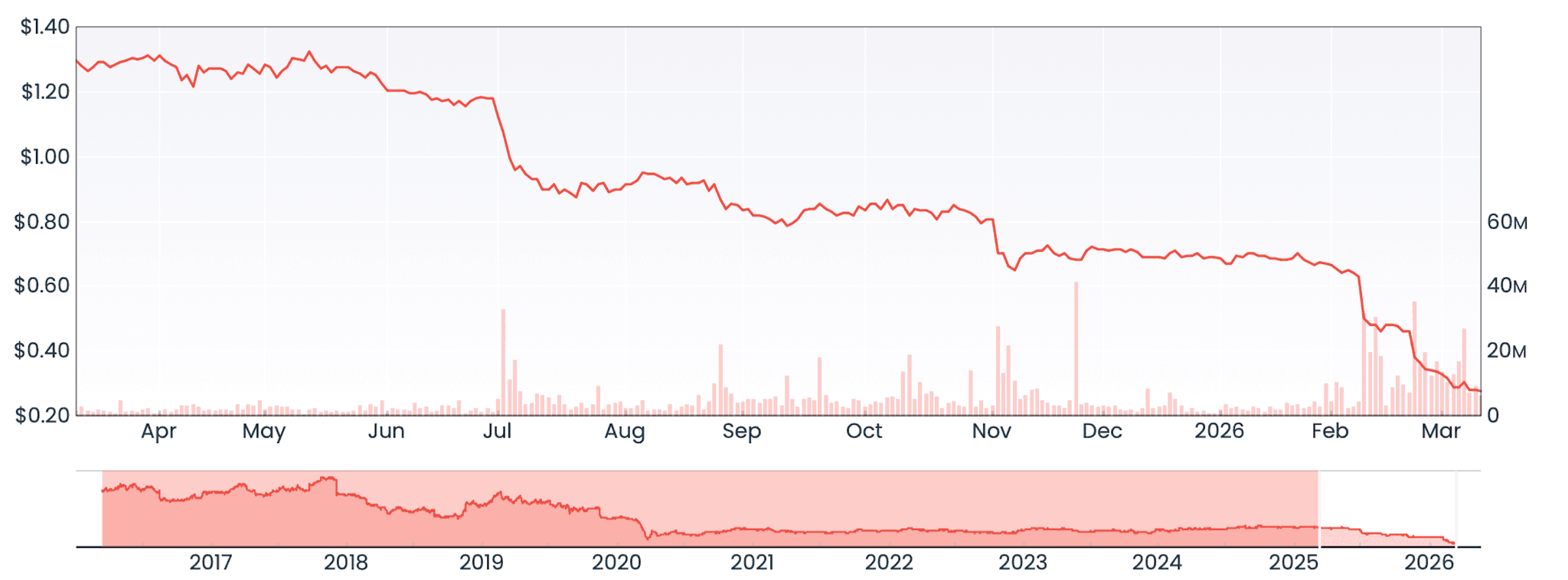
Market performance over the past 12 months provides additional context for the shifts in institutional investment.
Between March 2025 and March 2026, shares in G8 Education have experienced a sustained decline in market value. During that period the company’s closing share price fell from a high of approximately $1.325 in mid-May 2025 to $0.275 by 11 March 2026.
The movement has not occurred as a gradual downward trend. Instead, the period has been characterised by several sharper price adjustments accompanied by elevated trading volumes.
For example, in early July 2025 the share price fell below the $1.00 mark for the first time during the period, with more than 33 million shares traded on 2 July alone. Another notable drop occurred in early November 2025 when the price declined from approximately $0.805 to $0.70 within a single trading session.
More recently, the stock experienced further volatility in February 2026, falling from around $0.63 on 9 February to the low $0.30 range later in the month before reaching $0.275 on 11 March.
While share price movements can be influenced by a wide range of market factors, including broader economic conditions, portfolio rebalancing by institutional investors and sector-wide investment trends, the decline highlights the level of investor attention currently focused on one of the sector’s largest listed providers.
For the early childhood sector, which has seen growing private investment over the past decade, movements by large institutional investors highlight the continued intersection between education services and financial markets.
As one of the largest listed providers in the sector, G8 Education remains closely watched by investors, policymakers and sector stakeholders alike.
Movements in both institutional shareholdings and market valuation reflect the complex relationship between early childhood education services and the financial markets that support their expansion. For a sector increasingly shaped by large-scale investment, these shifts provide an important indicator of how capital is flowing through Australia’s early learning landscape.
Read G8 Education ASIC announcements here and investor information here.


Don’t miss a thing




Related Articles