The leader in the circle

 Article
How stepping into vulnerability transformed leadership and team connection at Possums Preschool.
Leadership in early childhood education often carries an unspoken expectation: that leaders will be strong, steady and able to hold everything together, even in the most difficult circumstances. For many years, I believed that was part of my role, that as a leader I needed to remain composed, resilient and unwavering for the sake of my team.
But the devastating Northern Rivers floods in 2022 challenged that belief in ways I could never have anticipated.
At Possums Community Preschool, the floods impacted not only our service but the lives of our entire community. Families lost homes and possessions, and many educators were also personally affected. Our much-loved preschool building was destroyed, and we suddenly found ourselves relocated to temporary premises while our community was still trying to comprehend the scale of what had happened.
As a leader, I felt an enormous sense of responsibility to support our educators, children and families. Yet the weight of what people were experiencing was overwhelming. Listening to families share stories of losing everything they owned was heartbreaking. Many children were navigating uncertainty and loss that was far beyond what we would normally expect in early childhood settings.
At times, I felt completely out of my depth.
No leadership training prepares you for the emotional responsibility of supporting a community through disaster and trauma. I wanted to be able to hold space for everyone, for the educators, the children and the families, but the reality was that I was carrying my own grief as well.
It became clear very quickly that I could not carry this responsibility alone.
The idea of “putting on your own oxygen mask first” is often spoken about in leadership conversations, but in practice it can feel uncomfortable and even unnatural. For me, it meant acknowledging that I also needed support. It required letting go of the belief that leaders should always appear strong and composed, and that showing emotion might somehow undermine my role.
In truth, the opposite happened.
Allowing myself to be vulnerable, to acknowledge and show my own sadness, grief and uncertainty, created space for others to do the same. What I had once seen as weakness became something else entirely: a pathway to connection and collective healing.
As a team, we gave ourselves permission to slow down and simply be together.
In the early stages, acknowledging my limited capacity, we engaged a professional to facilitate several group debrief sessions. These provided educators and myself with a safe and supported space to share their experiences and process the emotional impact of the floods. But beyond these formal sessions, we also discovered that healing often happened in quieter, more informal ways.
We gathered together, sometimes sitting around fires, talking, crying, laughing and sharing the worries and uncertainties we were all carrying. These were not carefully designed wellbeing strategies or structured leadership initiatives. We were all in this together. They were simply moments of human connection.
And they were exactly what our team needed.
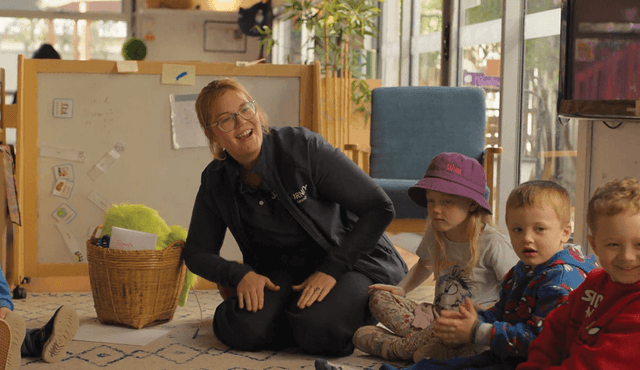
As a leader, stepping into that circle alongside my team, rather than standing in front, created a profound sense of camaraderie. It reminded me that leadership does not have to mean carrying everything alone. Sometimes it means standing alongside others, acknowledging shared experiences and creating the conditions for collective strength to emerge.
Through this process, I learned one of the most important lessons of my leadership journey: authenticity builds trust.
When leaders allow themselves to be human, to acknowledge uncertainty, vulnerability and emotion, it can deepen relationships within teams. It signals that it is safe for others to speak openly and that wellbeing is something we prioritise together.
This experience has changed me as a leader in lasting ways.
I no longer feel that I need to be everything for everyone. Instead, I recognise the importance of creating structures that support both my own wellbeing and the wellbeing of the team.
One of the ways I do this is through professional supervision. As part of my leadership role, I meet regularly with a psychologist for professional supervision. These sessions provide a valuable space to reflect on the complexities of working within the early childhood sector, unpack challenging situations and develop strategies for navigating the emotional and professional demands of leadership.
In turn, we have embedded professional supervision opportunities for our educators. Each term, every staff member has two one-on-one sessions with me. These conversations are guided entirely by the educator’s agenda, a time to connect, reflect and share whatever is most important for them.
Importantly, all educators also have access to the psychologist if they wish to seek additional support. Understanding the limits of my role as a leader is an important part of this process. While I can offer connection and guidance, there are times when professional support beyond the service is essential.
Looking back, the journey through disaster and recovery has reshaped my understanding of leadership in profound ways.
It has taught me that leadership is not about appearing endlessly strong or carrying every burden alone. Instead, it is about connection, honesty and the courage to acknowledge when support is needed.
Through vulnerability, shared experiences and the willingness to prioritise collective wellbeing, our team has emerged stronger and more connected than ever before.
And as a leader, I carry something different now.
Not the weight of trying to hold everything myself, but the understanding that true leadership is about creating a circle where everyone is supported, including the leader.
Author
Karen Shackell, Director at Possums Community Preschool


Don’t miss a thing




Related Articles