



Intergenerational care campuses are redesigning how communities support children and older Australians
 Article
Australia’s aged care and early childhood education and care sectors have traditionally operated in separate environments, each with its own facilities, workforce and daily routines.
An emerging model is challenging that separation. Intergenerational care campuses bring services for children and older people together through thoughtfully designed spaces and purposeful programs intended to create connection, learning and mutual benefit.
A recent Commercial Real Estate feature explored how this approach is influencing care design in Australia, and why successful intergenerational practice requires much more than simply placing two services on the same site.
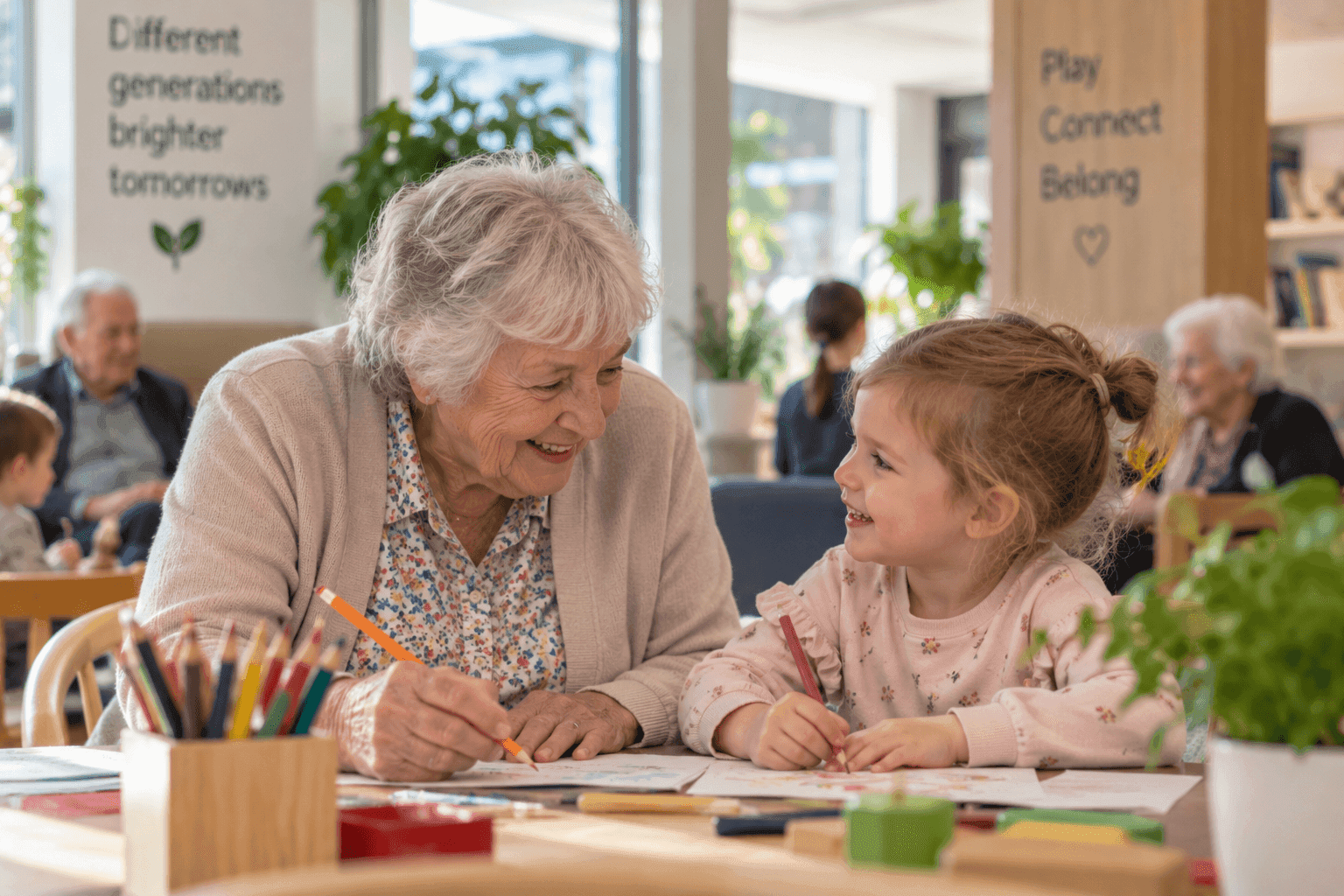
Intergenerational care can take several forms. Children may visit an aged care service, older people may participate in activities at an early learning service, or both services may operate within a shared campus.
The central principle is intentionality.
Emeritus Professor Anneke Fitzgerald, chair of the Australian Institute for Intergenerational Practice, explained that intergenerational practice must be based on reciprocity and mutual benefit. Children are not present simply to entertain older residents, and older participants are not passive recipients of an experience.
Instead, both generations should have opportunities to contribute, build relationships and learn from one another.
This distinction separates genuine intergenerational practice from occasional visits or performances. The activity may bring people together, but it is the relationship that develops over time that gives the model its value.
Purposefully designed intergenerational programs can create social, emotional and educational benefits for participants of all ages.
For children, regular engagement with older people may provide opportunities to:
- develop empathy and respect
- strengthen communication and social confidence
- encounter different perspectives and life experiences
- challenge stereotypes associated with ageing
- build a stronger understanding of community
- develop relationships beyond their immediate family and early learning setting
For older participants, intergenerational engagement may support social connection, participation and a renewed sense of purpose. Sharing stories, interests and knowledge can affirm the contribution older people continue to make within their communities.
Australian research has explored outcomes including social engagement, quality of life and relationships between generations. Although the evidence base is continuing to develop, existing findings support further investigation of structured programs designed around meaningful and reciprocal participation.
Simply constructing an early learning service beside an aged care facility will not necessarily result in connection.
The physical environment must create safe and accessible opportunities for interaction while recognising the very different needs of children and older people. Both groups need to feel that shared areas belong to them.
Design features may include:
- shared lounges and community rooms
- accessible sensory gardens
- flexible spaces for art, music and storytelling
- communal kitchens or dining areas
- clear visual connections between services
- safe and accessible pathways
- quiet areas where participants can withdraw
- spaces that support connection during illness outbreaks
- acoustic treatments that balance active and quiet experiences
The Herd, an intergenerational campus near Melbourne, demonstrates how architecture can support this approach. The campus includes an aged care service operated by Uniting AgeWell and an adjoining early childhood service.
Shared areas, a sensory garden and large viewing windows help connect the two environments. The windows have also allowed children and residents to maintain relationships when direct contact has been restricted, with activities including dancing, painting, games and treasure hunts conducted through the glass.
Buildings can create opportunities for connection, but relationships depend on what happens within those spaces.
Effective intergenerational programs should respond to the interests, abilities, cultures and preferences of participants. Experiences may include:
- gardening
- music and movement
- art and creative projects
- shared reading and storytelling
- cooking
- games and investigations
- community celebrations
- sharing cultural knowledge and traditions
The focus should not be on producing a performance or completing a predetermined activity. Programs should create the time and continuity required for participants to recognise one another, develop familiarity and establish genuine relationships.
Educators and aged care professionals also need the knowledge and confidence to facilitate these interactions sensitively. This includes recognising when someone does not wish to participate and adapting experiences to meet different communication, mobility, sensory and health needs.
For ECEC providers, intergenerational care must be underpinned by strong governance, clear responsibilities and service-specific risk assessment.
Important considerations include:
- child-safe recruitment, screening and visitor requirements
- supervision arrangements and educator positioning
- consent from children, families and older participants
- children’s right to decline or withdraw from an interaction
- privacy, photography and information-sharing arrangements
- infection prevention and illness management
- accessibility and mobility requirements
- emergency and evacuation procedures
- transportation risks where services operate at different locations
- medical, sensory and emotional needs
- responsibility for incidents, complaints and reporting
- alignment between the policies of participating organisations
Children should never be expected to hug, touch or interact with another participant. Their words, behaviour and non-verbal responses must be recognised and respected.
Older participants must have the same meaningful choice. Their privacy, dignity, personal boundaries and health needs should remain central to the program.
Intergenerational campuses may also create operational and commercial opportunities.
Co-location can support collaboration between professional teams and more efficient use of selected infrastructure and communal spaces. On-site early learning may be particularly valuable to aged care employees balancing work and family responsibilities.
For early childhood providers, an authentic intergenerational program may offer a distinctive educational model, strengthen community relationships and appeal to educators seeking a broader sense of purpose in their work.
Existing buildings could also provide a pathway for expansion. The childcare component of The Herd retained and adapted an existing building rather than replacing it, demonstrating how adaptive reuse may reduce development costs and give underused properties a new purpose.
Potential efficiencies must not, however, come at the expense of regulatory compliance or quality. Shared premises do not remove the individual obligations of aged care and ECEC providers or reduce the need for appropriate staffing, facilities, supervision and governance.
While intergenerational programs are operating in different forms throughout Australia, fully integrated campuses remain relatively uncommon.
Barriers include:
- workforce shortages across both sectors
- different regulatory and funding systems
- development and infrastructure costs
- infection-control requirements
- limited specialist training
- organisational risk and insurance considerations
- the complexity of coordinating two care environments
- the need for further long-term research
These challenges reinforce the importance of involving providers, architects, educators, care professionals, participants and families from the earliest planning stages.
Intergenerational care campuses represent more than a property or service-delivery trend. At their best, they challenge the assumption that people should experience care, education and community life in age-segregated environments.
For children, the model can broaden their understanding of relationships and community. For older Australians, it can create meaningful opportunities to participate, contribute and belong.
The success of these campuses will ultimately depend on whether providers move beyond co-location to create sustained relationships grounded in reciprocity, dignity, consent and choice.
When thoughtful design is combined with strong governance and purposeful practice, intergenerational campuses can become much more than two services sharing an address. They can become communities in which people learn, grow and find connections across generations.

Don’t miss a thing


Related Articles