



Shared smiles offer insights into infants’ early social interactions
 Article
New research explores how infants and adults influence one another during positive exchanges, offering early childhood educators a fresh perspective on everyday interactions.
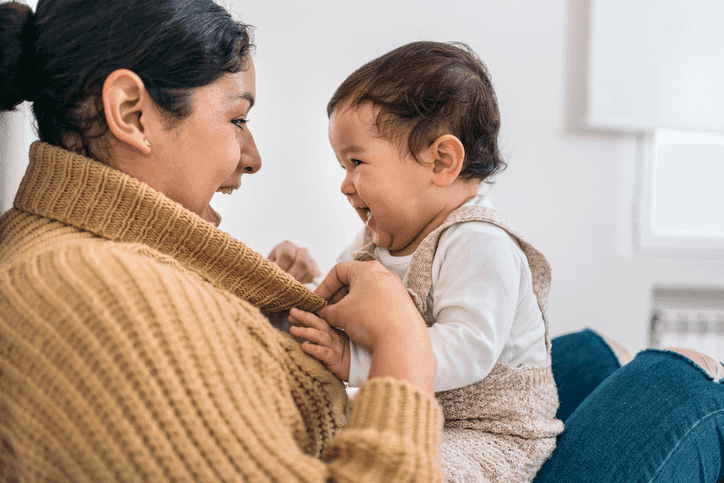
A baby smiles, an adult responds, and the exchange continues. Within that brief moment, both people contribute to the interaction’s timing and rhythm.
Two studies published in Philosophical Transactions of the Royal Society B on 24 September 2026 explore these exchanges from different perspectives: how infants and adults begin and end smiles, and how shared positive engagement relates to changes in infants’ physiology.
For early childhood education and care (ECEC) educators, the findings offer an opportunity to reflect on the child’s contribution to everyday interactions. They also require careful interpretation, as neither study examined relationships between infants and their regular educators in group care settings.
The first study, Smiling in time: the interactive development of infant smiling with mothers, fathers and strangers, followed 58 infants interacting with their mothers, fathers and an unfamiliar adult at four and eight months of age.
Researchers examined when each person started and stopped smiling, rather than simply counting smiles.
Adults initiated and returned smiles at higher rates than infants, while infants ended their smiles at higher rates. Adult smiles were associated with a higher rate of infant smiling, and infant smiles were associated with adults maintaining their smiles for longer.
At eight months, infants were more likely than at four months to initiate a smile when neither person was already smiling.
Interaction partners also mattered. Although unfamiliar adults initiated and sustained smiles at higher rates than mothers, infants were more likely to return their mothers’ smiles. Together, these findings suggest that infants contribute actively to positive exchanges and that their responses vary with the person involved.
Looking beyond facial expressions
The second study examined 974 four-month-old infants and their mothers from an at-risk research cohort.
Researchers measured respiratory sinus arrhythmia (RSA), a form of heart-rate variability linked to breathing, to explore physiological changes around positive interactions.
Infant RSA increased before episodes of mutual positive engagement and remained elevated after those episodes began. Comparable increases did not occur when only the mother or only the infant showed positive engagement.
The authors describe the analysis as exploratory and suggest a possible two-way association between social interaction and infants’ physiological responses.
The findings do not establish that shared smiling causes better emotional regulation later in childhood. They identify changes around particular moments of interaction, providing a basis for further research into how social and physiological processes relate.
A prompt for reflection in infant rooms
For Australian ECEC services, these findings are relevant to the existing emphasis on responsive relationships within Quality Area 5 of the National Quality Standard.
Element 5.1.1 recognises the role of responsive, meaningful interactions in building trusting relationships and supporting children to feel secure, confident and included.
A useful practice reflection is to consider how much space an interaction gives an infant to respond. During play and care routines, educators might notice when a child initiates contact, returns an expression, pauses or turns their attention elsewhere.
These are questions for professional reflection, rather than techniques tested by the studies. The research does not establish a target number of smiles or validate smiling as a measure of attachment or relationship quality.
It also leaves an important question open: how do these exchanges develop between infants and familiar educators over time in an ECEC setting?
The studies offer a reminder to pay attention to both participants. An adult’s warmth contributes to an exchange, while the infant’s response helps shape how it unfolds.


Don’t miss a thing



Related Articles