



Why evidence-based ECEC practice needs more than a training session
 Article
Finding a promising approach is only the beginning of changing practice in an early childhood service. Staff need time to understand it, decide how it fits their setting, use it with children and revisit what is working. New findings from the Australian Education Research Organisation (AERO) put that process, rather than a one-off professional learning session, at the centre of improvement.
AERO’s discussion paper, published on 23 September 2026, reports on its 2025 ECEC Learning Partner project. The organisation worked with long day care services in New South Wales, Victoria and Western Australia to explore how they could strengthen assessment for learning using AERO’s Early Childhood Learning Trajectories.
Fourteen services completed the project, including services rated Meeting and Exceeding the National Quality Standard. AERO’s findings draw on monitoring and feedback from service leaders acting as implementation coordinators, head office support staff and AERO consultants. This was a supported implementation project, so its lessons need to be read in that context.
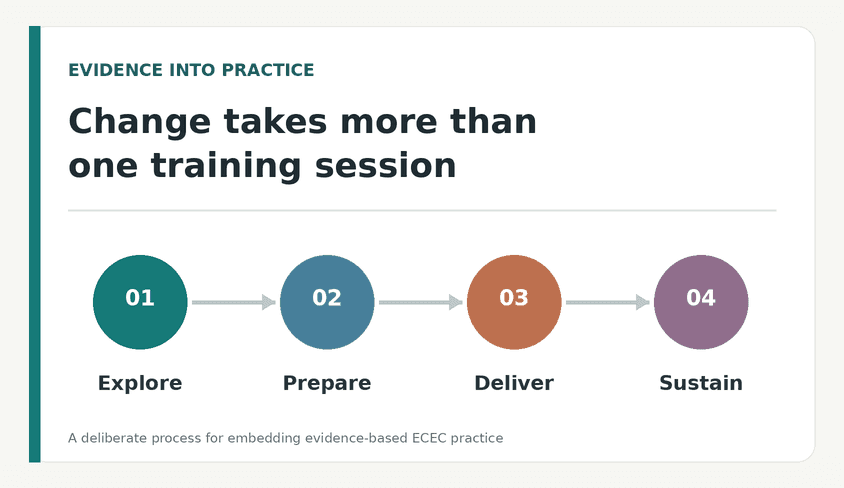
The paper considers what happens as services explore a practice, prepare to use it, deliver it and work to sustain it. Those stages are useful because a decision to adopt a resource does not mean everyone has the same understanding of its purpose or the opportunity to put it into practice.
For assessment for learning, the distinction can be concrete. An educator might recognise the value of observing children’s thinking but still need support to decide what to notice, how to discuss observations with colleagues and how those insights should inform the next experience offered to a child. Practice becomes more consistent when these questions are part of regular team discussion.
AERO identifies implementation planning, professional learning and ongoing consultation as strategies that helped participating services. A plan can set out responsibilities and timeframes; professional learning can build understanding; and follow-up conversations can surface difficulties that only become apparent once educators try a new approach. No single strategy carries the whole change.
The paper also highlights the part played by leadership within services and by support outside them. A nominated coordinator could help keep the work moving, but staff participation and the conditions created by service leaders also mattered. Where head office or external consultants were involved, services had access to another source of guidance and feedback.
That is a useful point for providers with multiple services. Sending the same resource to every centre does not ensure that each team has time to examine it, adapt its use appropriately and reflect on what happens. The experiences reported by AERO suggest leaders should ask what support educators need at each stage and who is responsible for providing it.
There is also a question for smaller or independent services: how can a leader create space for reflection when staffing and operational demands compete for time? The paper does not supply a universal timetable or staffing formula. It does show why implementation has to be treated as part of ordinary service work, with responsibilities that can be revisited, rather than as a task completed when a training session ends.
The participating Meeting-rated services reported larger gains in knowledge than the Exceeding-rated services, from a lower starting point. That is a measure of participants’ reported learning within this project. It does not show that a service’s quality rating changed or that children’s outcomes improved because of the work.
AERO has published the full discussion paper for services wanting to examine the methods and findings. Its strongest immediate lesson is about the conditions for change: educators need a shared purpose, support while they try an approach, and opportunities to decide whether it is working in their context.


Don’t miss a thing




Related Articles