




New workplace sexual harassment complaint options tool launched
 Article
Australia now has a clearer and more accessible way for workers to understand their options after experiencing workplace sexual harassment.
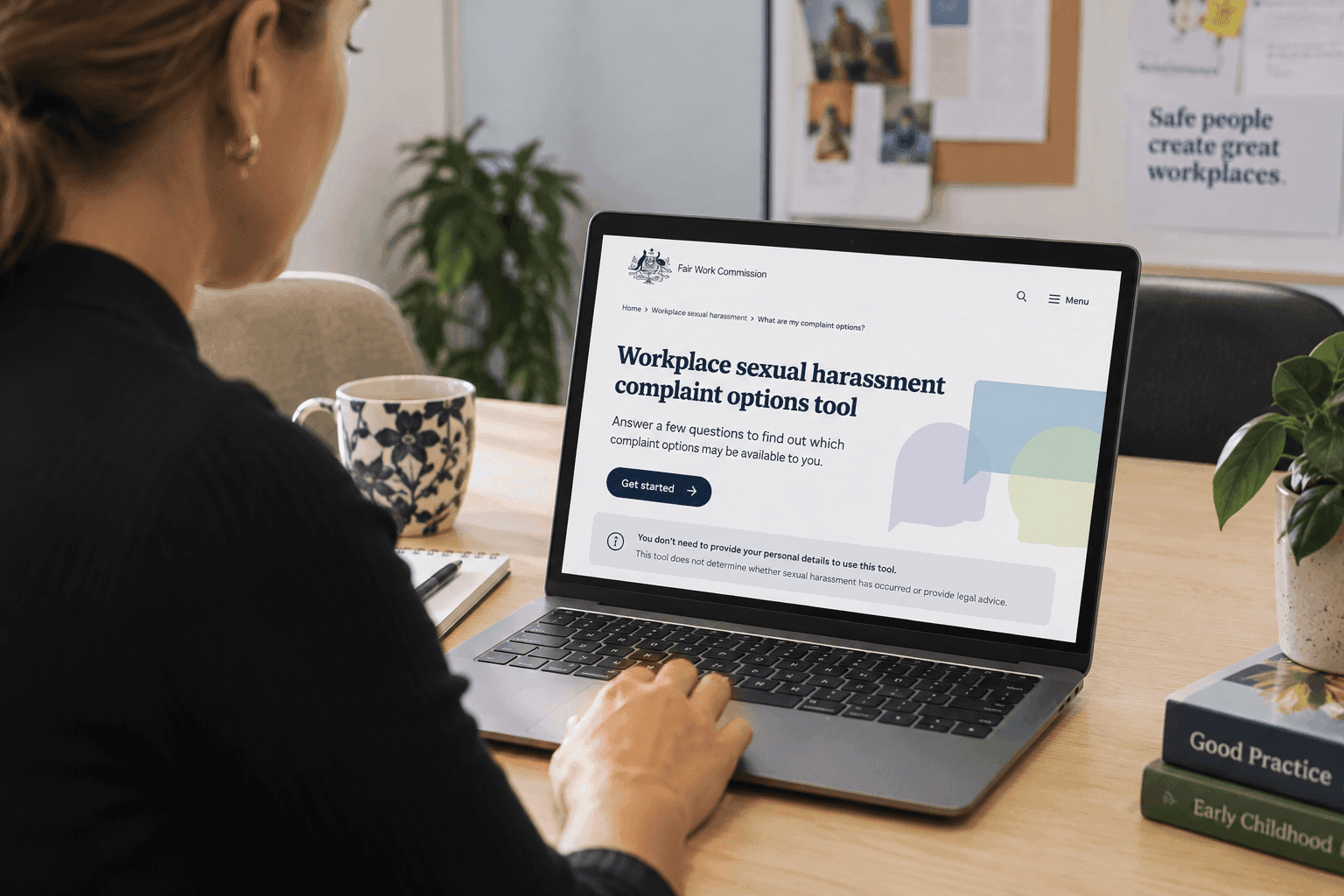
The Fair Work Commission has launched a new Workplace sexual harassment complaint options tool, designed to help people identify which complaint pathway may be appropriate for their circumstances without requiring them to provide detailed information about their experience.
Developed in collaboration with the Fair Work Ombudsman and Australian Human Rights Commission, and informed by feedback from Respect@Work member organisations, the interactive tool aims to make Australia’s workplace sexual harassment complaint processes easier to understand and navigate.
Workplace sexual harassment complaints can be handled by several government agencies in Australia. Each pathway has different:
- eligibility requirements
- time limits
- processes
- powers
- possible outcomes and remedies.
Generally, a person cannot pursue a complaint about the same conduct through more than one agency. Where a complaint begins can therefore affect how the matter is handled and the outcomes that may be available.
Understanding these differences can be difficult, particularly for someone already dealing with a distressing experience.
The new tool responds to this complexity by guiding users through a structured decision-making process and presenting information relevant to their answers.
Users are asked a series of yes-or-no and multiple-choice questions covering matters such as:
- whether the conduct may have involved a criminal offence
- when the alleged harassment occurred
- whether it resulted in physical or psychological injury
- whether the person remains connected to the workplace
- what type of assistance or outcome the person is seeking.
This may include wanting to report an incident anonymously, obtain an order to stop ongoing or future harassment, resolve the matter with an employer, request an investigation or pursue a matter through the courts.
Based on the responses, the tool provides plain-language information about options that may be available through:
- the Fair Work Commission
- the Fair Work Ombudsman
- the Australian Human Rights Commission
- state or territory work health and safety regulators
- workers’ compensation authorities
- police.
The tool does not determine whether sexual harassment occurred or provide legal advice. Instead, it helps users understand which agency or agencies may be able to assist them.
A central feature of the tool is that users do not need to provide identifying information or describe their experience in detail.
This allows people to explore possible pathways privately and at their own pace, while reducing the need to recount potentially traumatic experiences simply to access preliminary guidance.
Where conduct may constitute a criminal offence, including physical or sexual assault, stalking, indecent exposure or threatening communications, the tool directs users to contact police. Anyone in immediate danger should call Triple Zero.
The tool also highlights relevant time limits. Generally, people have two years to complain to the Australian Human Rights Commission or apply to the Fair Work Commission, although applications may still be considered outside this period in some circumstances.
The complaint options tool forms part of the Fair Work Commission’s broader suite of workplace sexual harassment information and educational resources.
These include guidance materials, support and legal assistance information, and a free workplace sexual harassment online course.
The 20-minute course explores what workplace sexual harassment is, its impact on people who experience or witness it, and the resources and support available.
For ECEC providers, the release is also a timely reminder that responding appropriately to complaints is only one part of workplace safety. Employers and people conducting a business or undertaking have a positive duty to take reasonable and proportionate steps to eliminate workplace sexual harassment and related unlawful conduct as far as possible.
Clear policies, trusted reporting processes, informed leaders and regular workforce education all contribute to creating workplaces in which employees feel safe to raise concerns and confident they will be taken seriously.
The new tool provides general guidance about national complaint options. Workers may also have rights and options under state and territory anti-discrimination, work health and safety and workers’ compensation laws.


Don’t miss a thing






Related Articles