




What Can Australia Learn from Ontario’s Child Care Ratios?

 Article
As workforce pressures continue to shape early childhood education and care (ECEC) policy discussions in Australia, international comparisons provide useful perspectives. Canada’s approach, particularly in Ontario, offers a case study in how educator-to-child ratios, maximum group sizes and qualification requirements can be legislated as an integrated framework.
The comparison is not about identifying a superior system. It is about examining regulatory design choices and considering whether elements of Ontario’s structure offer lessons for Australia’s National Quality Framework (NQF).
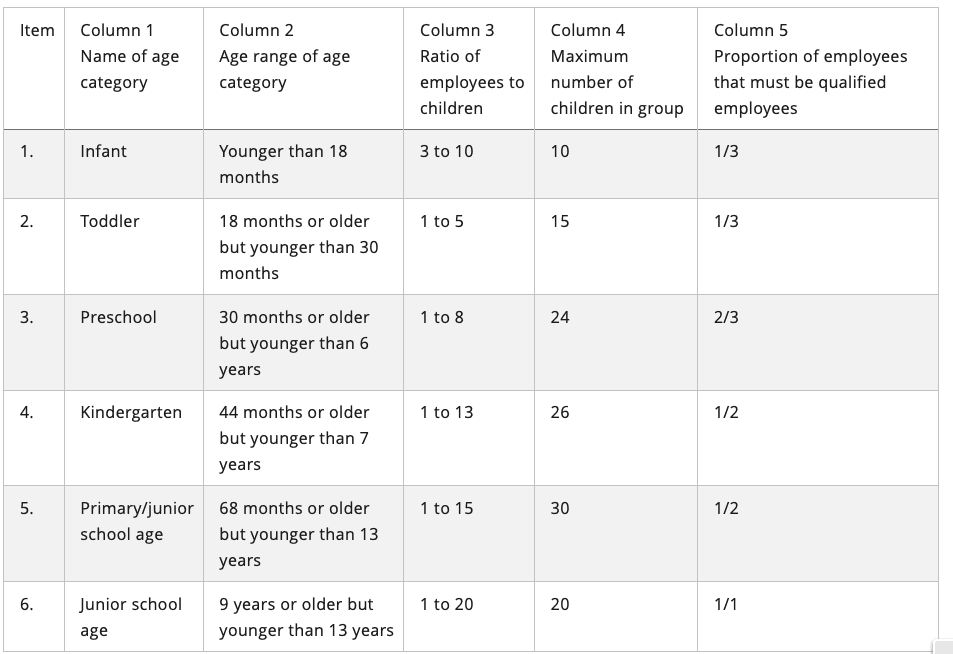
In Ontario, ratios, maximum group sizes and the proportion of qualified employees are prescribed together under Schedule 1 of Ontario Regulation 137/15 made under the Child Care and Early Years Act, 2014.
Ontario’s ratios for centre-based care are structured broadly as follows:
Under Australia’s National Quality Framework, educator-to-child ratios are prescribed in Part 4.4 of the Education and Care Services National Regulations, subject to jurisdictional variations.
Current centre-based ratios include:
- All states and territories: 1:4 for children birth to 24 months
- Most jurisdictions: 1:5 for children over 24 months and less than 36 months, except Victoria, which applies a 1:4 ratio
- Preschool age: 1:11 in ACT, NT, QLD, SA and VIC; 1:10 in NSW, WA and TAS
- Over preschool age: 1:15 in most jurisdictions; ACT applies 1:11
While the NQF establishes a national baseline, ratio settings are not fully uniform across jurisdictions. These variations create additional interpretive and operational complexity for multi-state providers.
Research suggests that staffing arrangements, including staff-to-child ratios, group size and staff qualifications, are recognised structural features of early childhood quality, though direct causal links to specific child outcomes are complex and varied across studies (Perlman et al., 2017; Munton et al., 2012).
International comparisons should not be used to justify lowering standards. Child safety, educator wellbeing and evidence-based practice must remain paramount under the National Quality Framework.
However, Ontario’s model invites consideration of whether Australia could review:
- The relationship between ratio and maximum group size
- How environmental scale influences educator workload
- Whether clearer structural alignment reduces ambiguity for providers
- How qualification requirements operate at room versus service level
As workforce shortages, demographic change and regulatory reform continue to shape the ECEC landscape, examining how structural elements interact, rather than focusing on ratios in isolation, may offer a more constructive policy pathway.
Comparing Ontario and Australia is not about transplanting one model into another system. Funding structures, workforce pipelines and cultural expectations differ.
However, Ontario demonstrates how ratios, group size and qualification requirements can operate as an integrated legislative framework.
As Australia continues to debate workforce sustainability and quality settings, reviewing regulatory design, not just ratio numbers, may provide a more meaningful foundation for reform.


Don’t miss a thing




Related Articles