



Introducing Nurtra: a childcare-focused CRM built for a changing ECEC sector

 Marketplace
With occupancy, family conversion and sustainable growth front of mind for many early childhood education and care providers, new platform Nurtra is bringing artificial intelligence, automation and enterprise-level customer relationship management tools into one childcare-focused system.
For early childhood education and care (ECEC) providers, generating an enquiry is only the beginning.
Families need to be contacted, tours booked, waitlists managed and follow-ups completed. Whether operating a single service, a growing group or a large network, keeping sight of every prospective family and understanding where opportunities may be slipping through the gaps, can be challenging.
Providers looking for technology to manage this journey have traditionally faced two broad options: use the relatively basic customer relationship management (CRM) functionality offered by childcare management software, or adapt an enterprise CRM platform that was not designed specifically for early learning.
New platform Nurtra has been created to sit between those two worlds.
Developed within the OWNA Group, Nurtra is a childcare-specific, AI-enhanced CRM designed to provide sophisticated lead and enrolment management while remaining accessible to providers of different sizes.
Importantly, the platform is being developed to remain software-agnostic, meaning providers will not need to use OWNA or Kidsoft to use Nurtra.
OWNA CEO Kheang Ly said the opportunity was to create sophisticated CRM capability around the way early childhood providers actually operate.
“Providers shouldn’t have to choose between basic CRM functionality and an enterprise system that needs significant customisation to work for early childhood,” Mr Ly said.
“Nurtra is being built specifically around the family journey in ECEC, with the capability to support an individual operator as well as growing and large providers.”
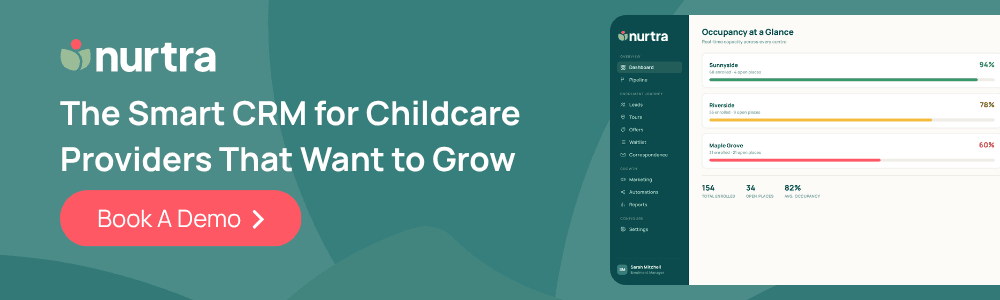
One of Nurtra’s key points of difference is its use of artificial intelligence (AI) to help providers understand what is happening within the enrolment pipeline and where attention may be needed.
Rather than requiring teams to work through multiple reports to identify potential problems or opportunities, Nurtra’s ‘smart CRM’ functionality is designed to surface relevant information.
AI tools can help score leads, identify potential churn risk and highlight gaps within the pipeline. A provider could, for example, ask where attention is needed and identify prospective families who have not recently been contacted or do not have a follow-up task assigned.
Mr Ly said the intention was to make the information providers already collect easier to understand and act on.
“The value of AI isn’t in giving providers another report to read. It’s in helping them quickly identify what needs attention and what they can do next,” he said.
“The goal is to surface opportunities, highlight gaps and reduce the amount of time teams spend searching for answers, so they can focus their attention where it will have the greatest impact.”
Nurtra brings the prospective family journey into one pipeline, from the first enquiry through to tour, waitlist and enrolment.
Lead capture tools include website chat and enquiry forms, while lead scoring and attribution can help providers understand where enquiries are coming from and which prospective families are engaging.
Web tracking and analytics provide further visibility, while automation can support families as they progress through the pipeline, reducing the need for teams to manually manage every communication or administrative step.
For larger and growing organisations, centralised pipeline management can also provide greater visibility across services and support more consistent approaches to family engagement.
Built with early childhood enrolment expertise
Nurtra is not being developed by technology specialists in isolation.
Enrolment Hub founder Jane Monaghan is working with the Nurtra team to help shape the platform, bringing her experience in early childhood enrolment processes to its development.
Her involvement is helping ensure Nurtra’s pipelines, workflows and follow-up processes reflect the practical realities of moving from an early learning enquiry to an enrolment.
Jane said successful enrolment management often comes down to what happens between the major milestones in a family’s journey.
“Receiving an enquiry is only the first step. What matters is what happens next, how quickly a family is contacted, how consistently the relationship is nurtured and whether there is a clear process for moving that family through their journey,” Jane said.
“When those steps are visible and consistent, providers are in a much stronger position to understand where families are in the process and where an opportunity may otherwise be missed.”
That sector knowledge is being combined with feedback from beta testers, including larger providers and smaller operators.
Pipeline stages can be adapted to suit individual organisations, allowing providers to create processes appropriate to their services rather than assuming every provider manages enrolments in exactly the same way.
For Jane, technology should strengthen the family relationship rather than remove the human element from it.
“Good enrolment practice has always been about relationships. Technology should make it easier for teams to maintain those relationships, not make the experience less personal,” she said.
“If automation and better visibility can take some of the administration away from educators, centre managers and enrolment teams, they have more capacity to focus on meaningful conversations with families.”
Enterprise capability without losing the childcare focus
Sophisticated CRM platforms have demonstrated what is possible when organisations can see and manage customer relationships across an entire pipeline.
For ECEC providers, however, implementing an enterprise CRM can mean adapting terminology, workflows and processes created for very different industries.
Nurtra starts with the early childhood context.
Its features include:
- lead capture through website chat and enquiry forms
- lead scoring and attribution
- pipeline management from enquiry and tour through to waitlist and enrolment
- AI-generated findings and recommendations
- family journey automation
- web tracking and analytics.
The intention is to provide functionality sophisticated enough for enterprise providers while keeping the platform practical for individual operators and smaller organisations.
Although Nurtra has been created within the OWNA Group, its positioning as a software-agnostic platform is deliberate.
Providers will not need to use OWNA or Kidsoft to access Nurtra.
The CRM is designed to manage the prospective family journey before enrolment information connects with the provider’s childcare management system.
Integration with other platforms forms part of the broader strategy. The development team also plans to connect Nurtra with marketplace listings such as KindiCare, allowing enquiries generated through those channels to flow directly into the CRM.
This approach is intended to allow providers to introduce more sophisticated enrolment management without necessarily replacing the core technology already used to operate their services.
While sophisticated CRM platforms are often associated with large organisations and dedicated enrolment teams, Nurtra is being developed with providers of different sizes in mind.
For an individual or single-service operator, that could mean creating a clearer and more consistent process for capturing and following up enquiries without adding unnecessary administration.
For a growing provider, automation and centralised pipeline management can help maintain consistency as the organisation expands.
At enterprise level, lead attribution, analytics and AI-generated findings can provide greater visibility across multiple services.
Feedback from both large and small beta testers will continue to inform how that flexibility is built into the platform.
Making every enquiry more visible
Occupancy is influenced by far more than a CRM.
Local demand, workforce availability, service reputation, family experience and the availability of places on the days families require care all play a role.
Technology cannot resolve every occupancy challenge, but it can provide greater visibility of what happens after a family makes an enquiry.
Where did the enquiry originate? Has the family been contacted? Have they toured? Are they on a waitlist? Has communication stalled? Which prospective families may be ready for the next step?
For providers focused on strengthening occupancy and sustainable growth, having ready access to those answers can help inform what happens next.
Nurtra aims to combine childcare-specific processes, automation and AI to make that family journey easier to see and manage.
In a sector where every lead represents a family making an important decision about their child’s early education and care, the technology may be new, but the relationship at the centre of the journey remains distinctly human.
To learn more about Nurtra, visit nurtra.ai


Don’t miss a thing


Related Articles