


Nature play and child wellbeing: an ancient solution for a modern problem
 Article
In a time when education, and childhood itself, is increasingly measured, assessed, and documented, it may seem counterintuitive to argue that one of the most important things we can offer children is less instruction.
Yet, that is precisely what children need and what nature provides.
Across Australia, educators are seeking solutions to crammed curriculums, overwhelmed administrations and disengaged children. In some cases, innovative teams are leading a growing movement back towards natural environments, outdoor learning, and child-led exploration.
While this approach may appear contemporary, the underlying principle is ancient: children learn best when they are free to engage with the world around them through curiosity, movement, risk, imagination, and wonder.
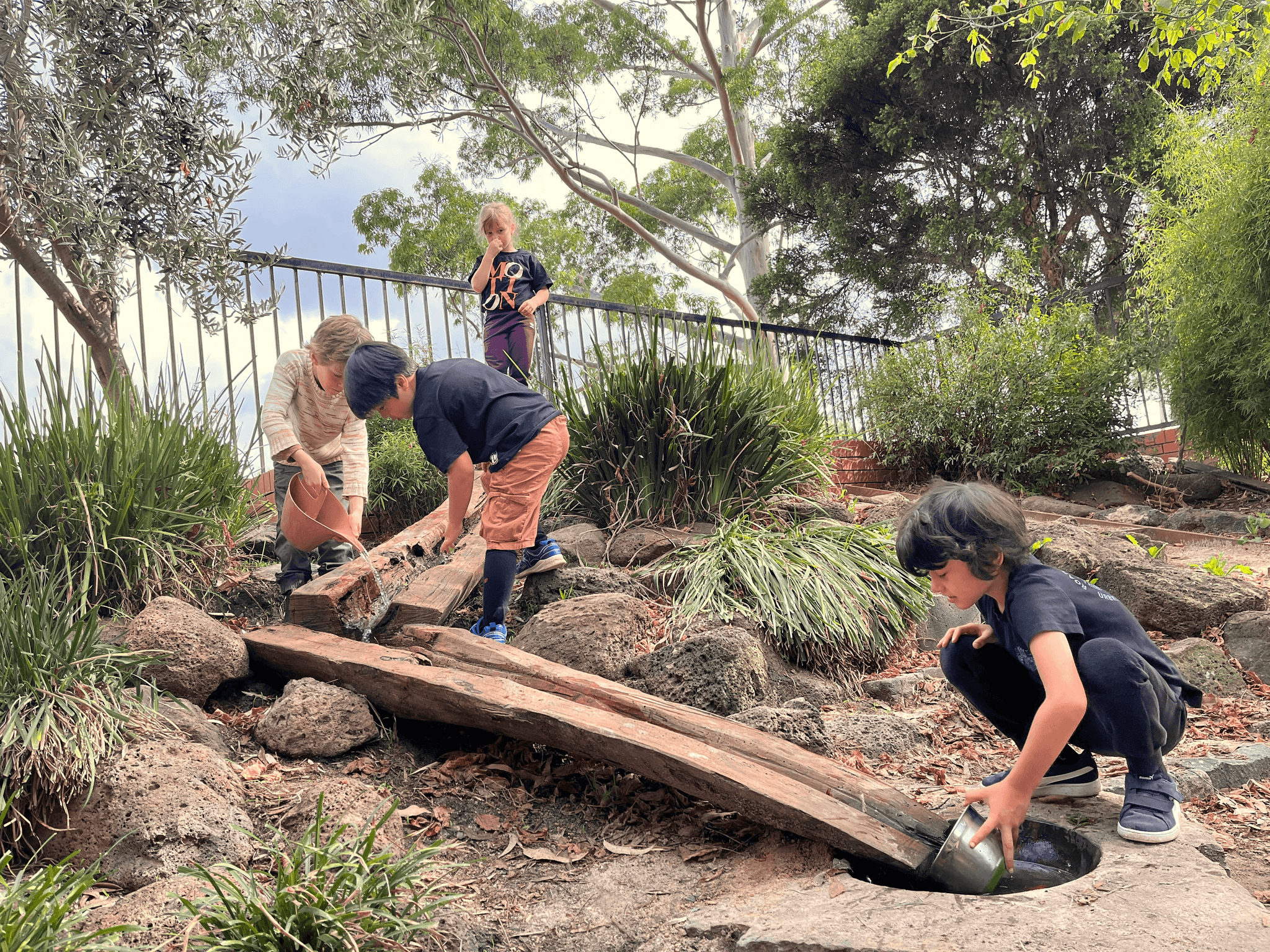
At an inner city Melbourne school a teacher describes a typical day in their recently developed natural playspace; “Each day, the garden comes alive with children gathering up their materials - baskets, sand, rocks, water, sticks, bark, watering cans, spades - and transforming them into worlds of their own making. Small groups can be found constructing intricate villages, creating waterways through the sand, building shelters from logs and branches, or inventing elaborate storylines that continue over many days. Through this process, children are developing problem-solving skills, resilience, creativity and independence. The learning is self-directed, social and deeply engaging. The children negotiate ideas, solve disagreements and adapt their designs together. What is striking is the sustained concentration and cooperation the children demonstrate - they are deeply focused and confident within the play.” - Sophia Mundi Steiner School
Nature play is not simply outdoor play. It is unstructured, open-ended engagement with natural environments and materials. Jenn Reed, the founder and director of landscape design firm Urban Discovery who specialise in nature rich play spaces, describes this type of learning as “earth based immersive play”.
This happens when children climb a tree, build a cubby from sticks, balance on a fallen log, dig in mud, chase insects, or spend the morning investigating a puddle. There are no prescribed outcomes, no worksheets, and often no adult direction or commentary of the experience.
For some, this can feel uncomfortable.
We live in a culture that has prioritised instruction over independence, explanation over exploration, and safety over satisfaction. In our desire to protect children, we have gradually removed many of the opportunities that previous generations took for granted. Trees are fenced off, risks are minimised, schedules are tightly managed, and children's time is increasingly spent indoors, in cars and in front of screens.
The unintended consequence is that many children are losing access to experiences that are fundamental to healthy development and wellbeing.
The research is becoming increasingly difficult to ignore.
In their recent paper ‘Nature play and child wellbeing’, the Australian Institute of Family Studies noted that nature play supports children's social and emotional wellbeing, helping them develop emotional regulation, autonomy, resilience, and positive mental health. Young children consistently report feelings of joy, calmness, excitement, and relaxation when playing outdoors. Studies have also found that time playing in nature can reduce stress, and improve sleep, confidence, self-esteem and decision-making skills.
Importantly, these benefits are not limited to wellbeing alone.
Nature-based play supports physical development through climbing, balancing, lifting, running, and navigating uneven terrain. Unlike manufactured playgrounds, natural environments offer endless variability and challenge. Every log is different. Every boulder presents a new problem to solve. Every season the landscape changes and evolves.
Children are not simply exercising; they are learning to assess risk, adapt, and trust their own capabilities.
This is perhaps one of the most overlooked benefits of nature rich play environments.
For decades, educators have discussed resilience as though it were a skill that could be explicitly taught. Yet resilience is rarely learned through instruction. It develops through age appropriate opportunities and experiences. Children become resilient when they encounter manageable challenges, experience setbacks, and discover that they can indeed overcome them.
A child balancing on a log develops far more persistence, judgement, and confidence than a child being told to "be resilient”, or worse “be careful”, ever could.
There is also growing evidence that nature play supports learning itself. A 2025 Sydney study involving Year One students who participated in a ten-week Bush School program, found improvements in wellbeing, engagement, collaboration, self-regulation, and mathematical development, with no negative impact on literacy or numeracy outcomes. Significantly, children described the experience not as a break from learning, but as a different kind of learning: active, relational, and purposeful.
This challenges one of the most common misconceptions surrounding outdoor education, that time spent outside somehow comes at the expense of academic achievement.
Perhaps the opposite is true.
Nature offers children opportunities for observation, experimentation, problem-solving, communication, social consciousness, mathematical thinking, and scientific inquiry in ways that are authentic and meaningful. A stone becomes currency. A creek becomes a physics lesson. A hut becomes a collaborative design project.
Learning emerges naturally because curiosity drives it.
For educators, this presents an important distinction and opportunity. Rather than viewing nature play as an occasional activity or enrichment program, we can begin to see it as a pedagogical foundation. It aligns powerfully with the Early Years Learning Framework through its emphasis on wellbeing, agency, identity, relationships, and connection to the natural world and is quite likely the only activity that can meet all areas of the Australian Curriculum for primary school students.
It also supports something increasingly important in contemporary Australia: children's relationship with the environment itself.
Research suggests that experiences in nature during the early years help establish lifelong connections with the natural world. Children who develop affection, familiarity, and respect for natural environments are more likely to become adults who value and care for them. In an era of environmental anxiety, this may be one of the most important educational outcomes we can offer children.
The challenge for our sector is not whether we know access to nature is valuable for children. The challenge is whether we are willing to make space for it.
That means incorporating nature into every educational setting, designing environments that prioritise natural elements over plastic equipment. It means allowing children time to become deeply engaged rather than rushing between activities. It means recognising that scraped knees, muddy clothes, and occasional discomfort are not signs of failure but rather evidence of meaningful participation and growth.
Most importantly, it means trusting children. Trusting them to explore, to make decisions and to take appropriate risks.
And trusting that the life phase of childhood itself is vitally necessary and intrinsically meaningful.
Nature play is not an optional extra, nor is it a nostalgic return to simpler times. It is a practical, evidence-based response to many of the challenges facing children, families and educators today.
In a world that is increasingly fast, digital, and structured, nature offers something profoundly valuable: space to soften, space to wonder, and space to grow.
Perhaps that is exactly what we all need most.
Author:
Hope Ryan, Earth Based Immersive Play & Holistic Pedagogy Consultant, Urban Discovery


Don’t miss a thing




Related Articles