



Fewer children using care as centre numbers and fees rise, latest CCS data shows
 Article
The number of children using Child Care Subsidy approved care fell in every state and territory in the June quarter of 2026 compared with a year earlier. At the same time, centre based day care services continued to grow nationally and average fees increased.
Australia had 1,393,620 children from 989,100 families in the Department of Education’s Child Care Subsidy (CCS) claimant cohort during the June quarter of 2026.
That was 30,280 fewer children, a decline of 2.1 per cent, and 16,700 fewer families, a decline of 1.7 per cent, compared with the same quarter in 2025. The proportion of children aged birth to five using approved care fell from 49.5 per cent to 47.8 per cent.
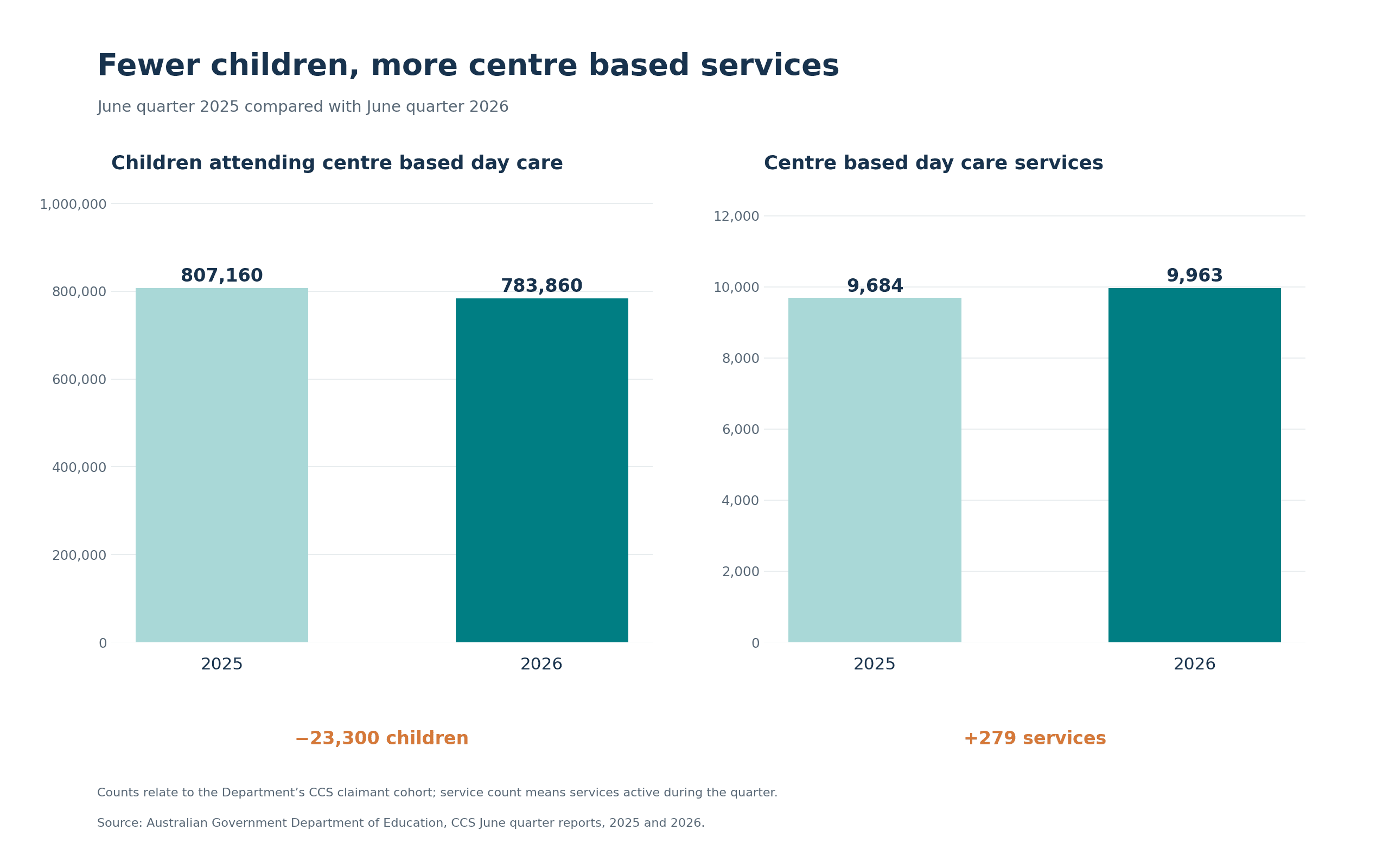
The number of services moved in the opposite direction. There were 15,438 CCS approved services operating during the quarter, up from 15,214 a year earlier. Centre based day care accounted for 9,963 services, an increase of 279, or 2.9 per cent.
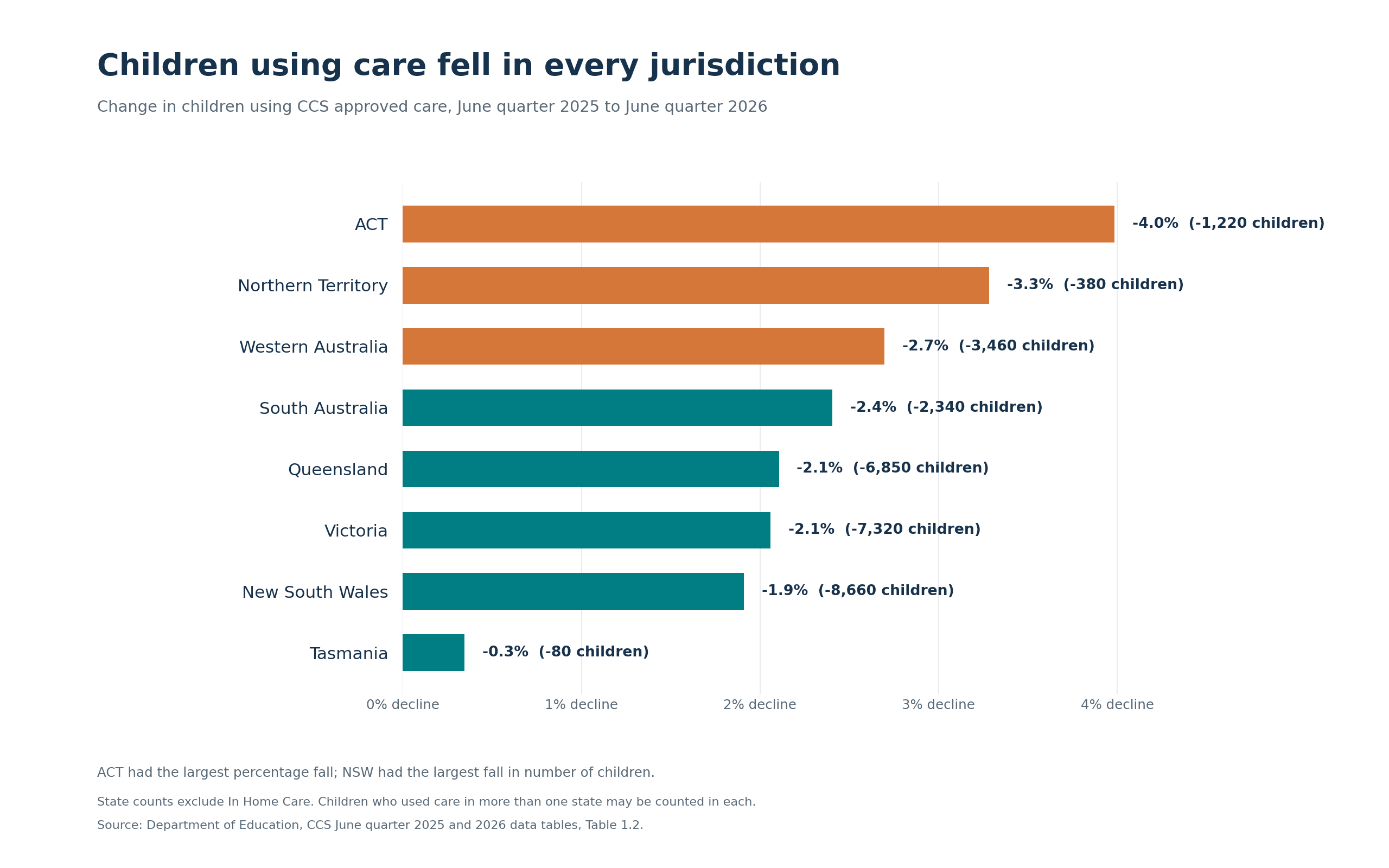
 New South Wales recorded the largest decrease by number, with 444,500 children using approved care, down 8,660 or 1.9 per cent from the June quarter of 2025. Victoria recorded 348,000 children, down 7,320 or 2.1 per cent, while Queensland recorded 318,420, down 6,850 or 2.1 per cent.
The Australian Capital Territory recorded the largest proportional decrease: 29,400 children used care, down 1,220 or 4.0 per cent. The Northern Territory was down 3.3 per cent, followed by Western Australia at 2.7 per cent. Tasmania recorded the smallest change, down 80 children or 0.3 per cent.
 Western Australia presents a particularly marked difference within centre based day care. The number of children attending fell by 3,070, or 4.2 per cent, while the number of centre based services rose by 51, or 5.5 per cent. Queensland also recorded fewer children in centre based care, down 6,570 or 3.6 per cent, alongside 42 more centre based services.
These comparisons show how participation and service growth varied across jurisdictions. They do not show occupancy at individual centres or establish why families’ use of care changed.
Centre based day care remained the most widely used care type, attended by 783,860 children, or 56.2 per cent of children in the report’s cohort. Outside school hours care (OSHC) was attended by 571,580 children and family day care (FDC) by 62,820.
Each of those child counts was lower than in the June quarter of 2025. Service numbers followed a different pattern: while centre based day care grew, OSHC had 23 fewer services and FDC had 30 fewer services than a year earlier.
FDC recorded the sharpest proportional fall in service numbers, down 8.5 per cent. The national figures do not show which local communities experienced those changes.
The average hourly fee across care types reached $13.90, a 3.8 per cent increase on the June quarter of 2025. Centre based day care had the highest average hourly fee at $14.60, followed by FDC at $13.95 and OSHC at $10.05.
The proportion of centre based day care services with an average hourly fee at or below the CCS hourly rate cap fell from 62.6 per cent in the June quarter of 2025 to 56.7 per cent in the June quarter of 2026. The cap for children below school age in centre based day care was $14.63 in the latest quarter.
Average centre based day care fees exceeded that cap in the ACT ($16.50), Western Australia ($14.90), New South Wales ($14.85) and Victoria ($14.65). The ACT also recorded the largest dollar increase in its average centre based fee, rising 80 cents an hour from a year earlier.
These are jurisdictional averages. They do not mean every service charges above the cap or show what each family pays after subsidy.
The gap between the national average centre based day care fee and the CCS hourly rate cap has narrowed from 29 cents in the June quarter of 2025 to just three cents a year later. Once a service’s fee exceeds the cap, CCS is calculated on the capped amount rather than the full fee, leaving families to pay the amount above the cap themselves. The effect on any family’s out of pocket cost depends on its subsidy rate, the service’s actual fee and how those amounts change over time
While the overall number of children using care declined, 68,140 Aboriginal and Torres Strait Islander children attended approved care, up 2.5 per cent from the June quarter of 2025.
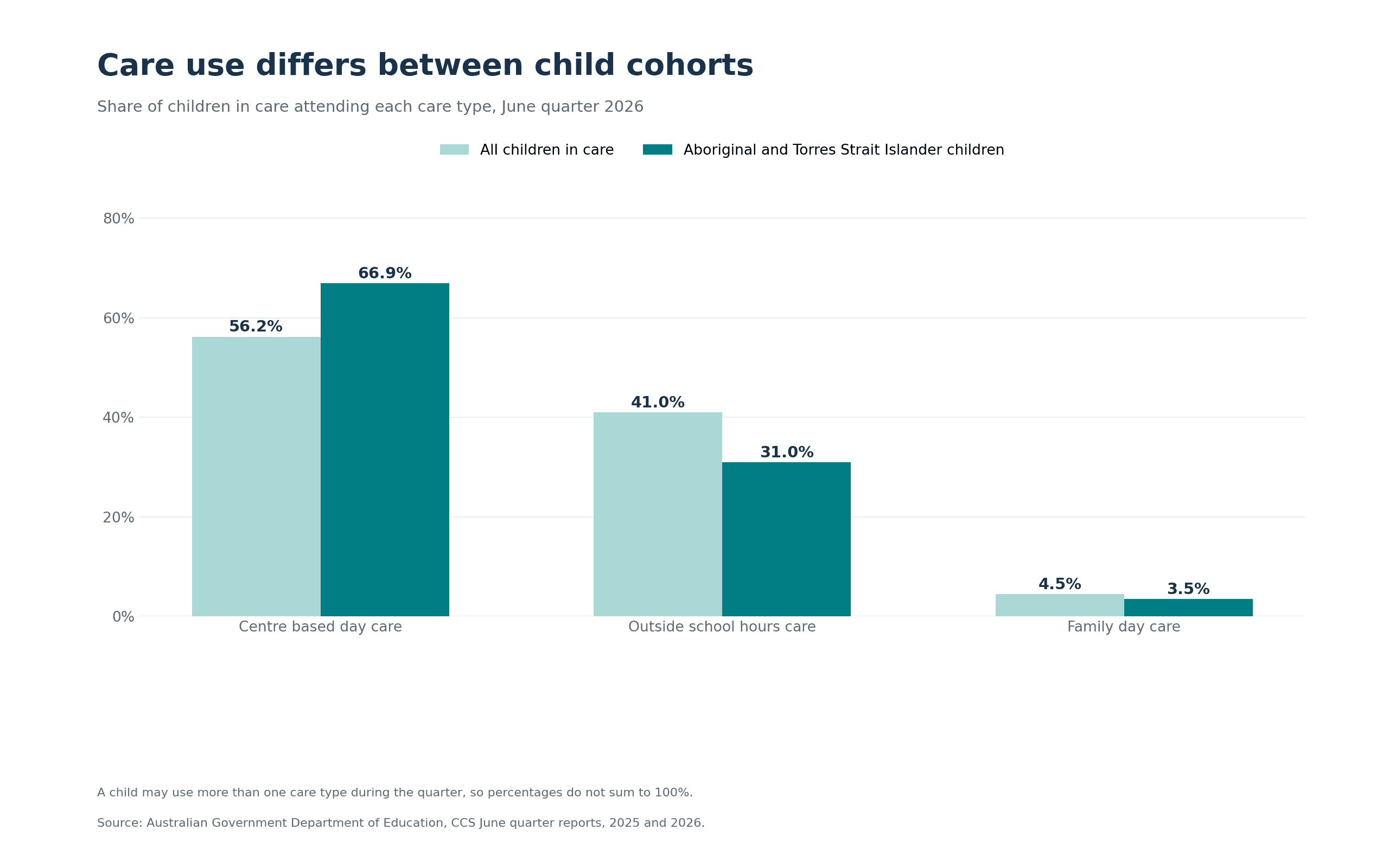 Centre based day care was attended by 66.9 per cent of Aboriginal and Torres Strait Islander children in care, compared with 56.2 per cent of all children in care. OSHC was attended by 31.0 per cent, compared with 41.0 per cent of all children.
Those differences show that patterns of care use vary between the cohorts. The report does not establish the reasons, but provides a starting point for examining access and choice across care types and communities.
Estimated Australian Government expenditure on CCS and Additional Child Care Subsidy (ACCS) totalled $3.88 billion for the quarter, up 0.7 per cent from a year earlier. Of that amount, $227.7 million was attributed to ACCS, compared with $194.3 million in the June quarter of 2025.
The number of children accessing ACCS rose from 43,000 to 47,180 over the same period. Centre based day care accounted for 85.1 per cent of estimated CCS expenditure.
The latest figures give providers a reason to examine their local enrolment and fee patterns alongside the national picture. They show fewer children using care across every jurisdiction, but considerable variation in the size of those declines and in the growth of centre based services.
The Department’s principal child and family figures cover CCS claimants whose children have a Customer Reference Number. A larger group of 1,456,930 children attended a CCS approved service during the quarter. State figures exclude In Home Care. Children using more than one care type or care in more than one state may appear in multiple component counts. Quarterly subsidy figures may change after annual balancing.
Access the full data here.


Don’t miss a thing



Related Articles